Wednesday, November 27, 2013

Another Way to Cook a Holiday Bird

A whole chicken, deep fried
Muzha, Taiwan

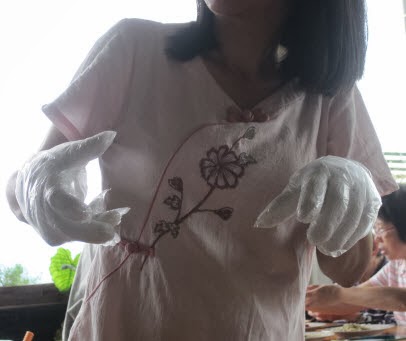
Well, here's another way to cook up a holiday bird - you can deep fry the whole thing!  And how do you serve the meat? Like this!  With oven-proof gloves covered in plastic. 

The turkey was very moist and delicious.  It's a local specialty.  At this feast (and feasting was a daily occurrence), we also enjoyed sauteed greens, bamboo shoots, eggs with pickled daikon (another local specialty), soft noodles with tea oil (below), fried shrimp, soup with fermented winter melon and bamboo, fried soft tofu, fried sweet potato, and a special seasonal green onion from a field nearby.

This Turkey Day, I am going bird-free again.  The DH and I are having a quiet dinner in front of the fire with cava (sparkling Spanish wine), cheese and crackers, and fruit.  Happy Thanksgiving to you however you eat your bird (or don't eat it).

Monday, November 25, 2013

Hiking in Sun Moon Lake Area of Taiwan


Old growth tea plants in between betel nut trees

I've been sifting through Taiwan Tea Tour photos and will return to blogging about that trip for a few days. 

One of the most physically engaging aspects of the trip was the time spent near Sun Moon Lake.  We did lots of hiking, much of it through betel nut/tea groves.  These tea bushes are old, from the Japanese Occupation era in Taiwan's history (~1895-1945).  Taiwan tea was a popular crop (black even!), but over time the market weakened and betel nuts became more of a cash generator.  Fortunately, the Taiwan tea market is finding its strength in black tea once again and these tea fields are becoming lucrative.  In the photo above, the darker green bushes are the tea plants.


One fine morning after an interesting breakfast of pesto sandwiches, hot dogs with relish, sweet potatoes and eggs, we set off.  (The place we stayed, Black Tea Workshop - and I highly recommend it - was offering a 'European' experience.  I think something was rather  humorous in the breakfast interpretation.)  Then we set off to climb up, up, up...


And past signs like this...  It took me awhile to figure out that our guide (above) was banging his walking stick into the bushes not because it was great fun, but rather because it was scaring the snakes away.  I'm not a fan of snakes and prefer they stay out of sight.  I am very glad that they did.


We crossed a beautiful creek


On a rickety bamboo bridge...
   
And we all survived!  (Note to my traveling companions - this  image and the first one are actually from the day before).


Friday, November 22, 2013

Bamboo Vase

Bamboo vase with rose hips

I've always liked the look of bamboo, but after a recent class on carving bamboo scoops and making bamboo vases, I am even more enamored with this plant.  Technically, bamboo is a grass.  It's strong and grows quickly, making it a wonderful renewable resource. 

I had help in making this bamboo vase, from my Chado teacher. What's cool is that in between each bamboo node, the plant is hollow like a tube.  Using a Japanese hand saw and a vice grip, I very carefully cut just above and below nodes to make the desired length.  Then we used a chisel to cut out a hole in the middle (where the flowers go).  The final step was to drill a hole in the back for hanging.  When I have plants that need water, I use a plastic baggie tied around the bottom of the stems and tuck that inside the tube.  (I don't want mold to develop inside the bamboo tube.)

It hangs in my entryway.  I love it!

The DH, making sure I don't take myself too seriously   

Monday, November 18, 2013

Herbal Teas for the Evening


Ginger-Thyme Tea

Hello, blog readers - As the nights grow longer, darker and cooler, I find myself wanting a warm beverage to sip in the evening.  And more often than not, I want that beverage to be without caffeine.  I'm fortunate that we grow many herbs in our garden and I'm often able to make a fresh herbal tisane, like above.  I also enjoy dried herbal/flower teas.  I recently picked up some dried plum blossom and a friend gave me some linden flower tisane (more on these later!)  What are YOUR favorite herbal brews?  Does anyone dry your own herbs?  Any tips there?

Recently, I was approached by the Buddha Herbs company to review some of their blends.  Given my interest in herbals these days, I agreed.  I was expecting a handful of herbal tea bags, so imagine my surprise when I received a giant box in the mail with several boxes of herbal teas as well as supplements!  I have been enjoying the herbal blends, particularly the raspberry leaf. The DH has been drinking the chamomile.  (I don't drink chamomile because of allergies - it's in the ragweed family.) I am also sharing the generous bounty with a local community group that regularly has meetings over coffee/tea, and they send thanks as well!

Wednesday, November 13, 2013

Watermelon Radish and How I Write a Blog


Watermelon Radish

Way back in 2005, when I started this blog - Wow, really?  Has it been that long?! - I thought first about the message I wanted to write and then maybe added in a photo that kinda-sorta fit.  That was before I dove down the DSLR camera rabbit hole. 

These days, I just as often start with the photo and then craft the message.  That doesn't mean the message has taken a back seat.  Rather, I've thought in generalities about what I want to say much earlier in the timeline.  When I'm taking photos, my mind sees potential story threads to match the experience I'm shooting.  Back at my desk, I let the images weave that thread together with the other parts of the story.

And then...
Sometimes I just have an image that I want to share.  Like the watermelon radish above.  This picture makes me SMILE every time I see it and I wanted to share it with you.  There is a story here:  The DH grew these.  Sometimes they have a spicy bite and sometimes they don't.  And I love them for their cheery colors. 

If you write a blog, how do you go about crafting your stories?  And do you sometimes post photos just because?

Thursday, November 07, 2013

I Know How Much Work It Is...

Homemade macarons

I know how much work it is to host an afternoon tea gathering.  The planning, the shopping, the cleaning, the decorating, the cooking, the cleaning again, the presentation.  (This doesn't even touch on making homemade macarons!!)  It's a labor of love, but it's also an endurance sport.  That's why when I'm invited to a tea party, I am so appreciative!  And when that tea party is hosted by a dear friend when I visit from far away, and she brings together friends I have not seen in a long time, my heart swells with gratitude.  I was honored with this very thing on a recent visit to the Midwest.


Each place setting was unique

I was so busy catching up (and enjoying the food) that I neglected to take photos of all the courses.  However, everything was scrumptious and beautifully presented.  There's just something about an afternoon tea, isn't there?  The beauty invites me to slow down and savor.  The tea encourages me to listen and to share deeply.  And I believe the love put into preparing the event and each morsel is amplified and returned to the hostess.

Artistry in the sweets

Monday, November 04, 2013

Enter with Joy

My tree-lined street, vibrant with color


I used to feel a little sad when autumn would come.  I knew the days would grow shorter, darker and colder.  But over the past few years I've re-programmed myself to welcome fall with joy.  I welcome the color, the seasonal produce, the crunch of dry leaf, the smell of wet leaf, the crisp air, the pause.  And now, I even welcome the rain, the grey and the cooler temps.  I've learned to embrace warm mugs of tea and toasty socks, movies and books, nesting and inward reflecting.  

How do you welcome fall?


My front door

Tuesday, October 29, 2013

Tea Blossom


Camellia Sinensis blossom

My tea plant has had a beautiful flush (growth spurt) this autumn, including a profusion of flower buds. I love to follow the fat, round buds as they develop into this simple flower.
Notice the fall leaves in the background, also reflecting on the front edge of the dish

We (meaning the DH) recently moved the tea plant into a rather large pot and it will be spending its first winter outside on the back balcony.  It's doesn't get super cold (or hot) where I live, and so I think it will be happy there.

Do you have a tea plant?  Does yours live inside or out?


Friday, October 25, 2013

What is Yerba Mate and How Do I Make and Drink It?

A formal mate gourd and the loose leaf brand my friend prefers

I am very happy to co-author this blog post with my good friend, AM.  I recently had the wonderful opportunity to learn about and drink yerba mate with her family and some other tea friends.  Yerba mate is the plant from which the beverage "mate" is made.  While this is indeed an herbal (it's not from the camellia sinensis tea plant), it's a bit of an anomaly in the herbal world.  It contains caffeine - or to be technical, a chemical compound that some believe is caffeine and others believe is close but not the same.  Either way, it contains a stimulant and should be sipped with that in mind.  I find the beverage to be savory and filling.  It's flavor is a complex blend (to me, anyway) of vegetal, herbal and a tiny pinch of mint.

I am happy to share the rest of this blog post with you, written by AM who is from Argentina, one of the South American countries where yerba mate is part of many people's life.  Enjoy!

Mate is an infusion made with yerba mate and drunk all over southern South America (Argentina, Uruguay, Paraguay and southern Brazil mainly). Yerba mate is a large bush with bright green leaves that grows in warm, humid climates. You may have seen it here in the US in the form of tea bags or as iced tea. In Argentina, the traditional way is to drink it communally out of a hollowed out and dried gourd, with a metal straw.
A less formal gourd, beautiful in its simplicity

The way it works is this: the host or the person who decides to make mate (in my parents' house, it's almost always my dad) fills the mate (the hollowed out gourd is called the mate) with yerba mate (about 2/3 to 3/4 of the way up usually) and then, before pouring the hot water in the mate for the first time, you need to add a splash of cold water (a teaspoon or so), to settle the leaves and prevent them from burning. Then you fill the gourd with hot water on the verge of boiling. The host drinks the mate with the straw until there's no liquid left. This is done rapidly, usually within a minute or two. The host pours water in the mate again and sometimes drinks the second one as well. The reason for this is that the first pour (and even the second) tends to be very strong. The host pours the next mate and hands it to a guest, who drinks it rapidly (within three minutes usually) and returns it to the host. The host refills the mate and hands it to the next guest. The order is determined depending on where people are sitting. (It proceeds in order, in any direction, from the place where the host sits. Mate can move clockwise or counterclockwise. The host decides). The mate then moves around the table until it's the host's turn to drink again. The host is the only person to pour water into the mate.

The mate drinking circle continues until people don't want to drink anymore. At any time, you can say "thank you" and drop out of the mate drinking. The host continues serving until people no longer want to drink. If the infusion gets too weak, the host may decide to change the yerba mate and start anew with fresh yerba mate.

Don't move the straw!  That stirs up the leaf and you want it to stick in place

Yerba mate is green and is a mix of dry, often powdered, leaves and twigs. The flavor is intense, herbal and somewhat bitter. For most people, it's an acquired taste. Like tea and coffee, it has a stimulant effect.

The usual times to drink mate is in the morning, with breakfast, or as an afternoon break with pastries or cookies to go along with it. Some people drink it in parks, beaches and during road trips. In Argentina, you can easily get hot water for your mate-making needs in gas stations. 

Have you enjoyed mate?  How about in the traditional way?

Wednesday, October 16, 2013

Huckleberry Scones


I'm about a month late in writing about this...
Back in mid September, the huckleberries were ripe in the Pacific Northwest.  I was not familiar with huckleberries - are you?  They grow well here and are important to Native American cultures.  Apparently they grow in the Northeast, as well.  They're similar to small blueberries, only firmer and with their own tart-sweet flavor.

The DH (dear hubby) made whole wheat huckleberry scones.  Mmmmm!


I also made a huckleberry syrup, which is great on pancakes.  Below,  I'm using the syrup over a grilled nectarine.

Do you enjoy huckleberries?  How do you use them?


Saturday, October 12, 2013

What Is Oolong (Wulong) Tea?

Ti Guan Yin tea in Muzha, Taiwan

What is oolong tea?  This is perhaps the most difficult Tea 101 topic I've written.  The tea is not one tea, but rather a range of hundreds (maybe thousands?) of teas that range between light and fresh to dark and roasty.  Technically, oolong tea spans the broad chasm between a green and a black.  Oolongs vary in many factors, but fundamentally, the variation is based on the amount of oxidation that the leaf undergoes in its process, from ~10% up to 75 (perhaps 85)%.  Factor in the local growing conditions, the tea farmer's skill and the tea maker's artistry, the roasting (if it applies), whether the tea is balled or twisted, the storage, the water, the brewer - and you have innumerable variations. 

The magic, to me, of oolong teas is in their diversity.  An oolong honors its provenance, forms a partnership with the tea farmer, yields to the hand of the tea maker and expresses itself uniquely for the brewer.  From the very green and minimally oxidized Baozhong, to the high mountain fragrant teas (like Alishan), to the highly oxidized Bai Hao oolongs to the deeply roasted traditional Ti Guan Yin or Wuyi teas, I hold that there is an oolong for everyone.  My tastes change based on the season and my mood, but I am generally drawn toward the heavily oxidized and/or roastier versions.  But wow how I appreciate the heavenly aromas or creamy mouth feel of others.

Baozhong oolong tea in Pinglin, Taiwan

Oolong tea processing originated in China, possibly the Wuyi region.  Today, Taiwan joins China in production of incredible oolong teas. (Some people believe the best oolongs are from Taiwan, but this is a highly personal choice.  I find great teas from both China and Taiwan.)  I had the wonderful opportunity to tour Taiwan last May and I've been blogging about it off and on, and will continue to do so.  The photos in this post are from that trip.

Oolong teas are often (and I find best) brewed in gong fu style.  This style of brewing invites us to slow down and be with the tea, and with our sipping companions.  (Here is a simple primer on one gong fu method.)  You may have heard of those tiny yixing pots; those are perfect for Gong Fu brewing, but porcelain and glass work well, too - as does a gaiwan.

Tell me, my tea friends, do you enjoy oolong teas?  If so, which ones and why?  And if you're just beginning to explore this style, please feel free to ask me questions.  I am by no means an expert, but I am a diligent student and can share what I've learned from those far more experienced than I, and from my sipping experiences.  And that sipping is the best way to explore and learn!

Friday, October 11, 2013

Day of the GIRL!


GirlRising.org

Today is the International Day of the Girl, a call to action on behalf of our tender world.  And I say world because when we educate our girls, the world benefits.  Over 66 million girls are out of school today, simply because they are girls.  They carry water and care for younger children, they forage through trash for metal, they work as "bonded" servants - little more than slaves, they are married very young, or worse.  In fact, I learned last night that the leading cause of death of girls ages 15 - 19 in developing countries is childbirth/pregnancy complications.  Yet we know that when we educate a girl, even one more year, she is full of benefit not only for herself, but also for the community and ultimately our highly connected and fragile world.  "Providing girls one extra year of primary school education can increase future wages by 10 to 20 percent, and an extra year of secondary school increases future wages by 15 to 25 percent. Secondary school also offers a valuable opportunity for girls to learn healthy behaviors. In some countries, for example, AIDS spreads twice as fast among uneducated girls."  Source:  Educating Women and Girls, US Department of State (see previous link). 

I watched the Girl Rising film last night.  It's full of both nightmare and dream.  It's a film made to move us to action, as it  highlights girls who have chosen to continue toward an education despite their significant challenges.  Like Suma (above), who lives in Nepal.  This beautiful woman was once a small child who became a servant at an extremely young age.  Her parents, destitute themselves, thought it would be a better life for her.  But she suffered severely.  Through the help of social workers, she was eventually removed from her role as a bonded servant and rejoined her family.  Today, she is helping to do the same for other girls.

If you get the chance to see this film, please do.  (Disclosure:  I am proud that my employer is a sponsor!)  The film is being dispersed in a non-traditional way....once enough people sign up to view it in a particular venue, it's brought there.  There are also options for hosting home and organizational viewings.

So let's be grateful for the little girls in our lives - those we hold to us each day and those who need us to hold them in our hearts and actions.

Wednesday, October 09, 2013

NW Tea Fest 2013 Summary

NW Tea Fest 2013
Click image to enlarge

The NW Tea Fest has become an annual highlight of my tea life.  This year's event was wonderful.  And by event, I mean not only the actual Tea Fest, but also the surrounding visits with Seattle tea professionals and the in-person meeting of blog friends from far away.  It's a weekend of sipping and sharing and wonderfulness!  

Visit some of my friends in the tea biz (listed alphabetically by first name):

Asia Pacific Cultural Center:  Korean Tea Ceremony
Darlene: Tea Lover's Archives, I loved meeting this blog friend in person!
Jeffrey: McIntosh Teas (unfortunately, the late night tea drinking photos didn't turn out)
Roberta: Experience Tea (not shown in photos; Roberta helped bring in the Korean Tea Ceremony)

Saturday, October 05, 2013

Tea Euphoria

Guitian preparing tea

Living the tea life at the NW Tea Fest!  Euphoric is the right word. Tasting all day and drinking tea with friends late into the night. Above, a moment of beauty and transcendence with Guitian. http://www.guitiansteaclub.com/ 

Thank you dear tea friends. 

Tuesday, October 01, 2013

My Little Tea Fairy

Fairy House

I recently had the great pleasure of spending several days with my niece.  F-U-N!!  We had glorious early fall weather.  We built a fairy house and used acorns for tea cups.  
Aprons by my dear friend Sweetcakes

We made scones for a tea party, wearing these matching tea cup aprons.  By the way, we used Cup4Cup gluten-free flour and it was great!  The magic ingredient to the scones was to top them with pink sugar sprinkles.  


And I couldn't help myself.  I made matching outfits.

Making memories for a lifetime!  

Friday, September 13, 2013

Some Tea News and Events


Image from Edible Portland

Tea Growing in Oregon!  The fall edition of Edible Portland features tea growing in Oregon!  Read it here and/or listen to the OPB interview.


Sunday, September 15th, 5 – 7 pm:  Pu-Erh Tea Tasting

A special tea tasting event at Newspace Center in Portland, Oregon. Jeffrey McIntosh of McIntosh Tea and Nicholas of Mist Peak Teas will be teaming up for an evening of exquisite tea, great company, and the opportunity to be a part of growing interest in the famous tea from the mountains of Yunnan, China, Puer Tea. More info and to register.


Learn Wu-Wo Tea Ceremony in October at the NW Tea Fest in Seattle!

When: NW Tea Fest is Saturday – Sunday, October 5 – 6
Location: Seattle Center
Conference website: http://www.nwteafestival.com

Register early! Last year we had a very full event!

Class info:  Experience the Wu-Wo Tea Ceremony
(Instructor: Dewey Meyer)
Saturday, October 5, 11 am – Noon

Large Workshop Booth - ($10 materials fee for brewing participants – 10 brewing spaces available)
Up to 25 additional non-brewing participants

Wu-Wo Tea Ceremony was created in Taiwan in the 1980′s as an experience that allows many participants to brew and serve tea together. It is rooted in Chinese Gong-Fu small pot brewing. Wu-Wo translates to “selfless” and embodies that principle. Participants sit in a circle and silently brew, being present with tea, nature and each other. Those that you serve are not the ones you receive from, reinforcing the concept of giving without expectations.

Please join us! No need to bring anything. We will provide 10 brewing kits. 10 people who pay a $10 materials fee will be able to use these kits and be an active brewing participant in the ceremony. All participants, including non-brewers (which can attend at no fee), will be able to taste tea during the ceremony.

Monday, September 09, 2013

Cha-Kaiseki: The Meal at a Japanese Tea Ceremony

Me, drying dishes after cleanup of the meal at a recent kaiseki class


I have some serious foodie friends who will enjoy this post...

If you are invited to a full Japanese Tea Ceremony, you will first be treated to a delicious, light and healthy meal in the tea room prior to enjoying the tea.  The idea is to ensure the guests' comfort during what can be a lengthy and leisurely tea event.  The food helps keep us contented, and some people's bodies are better able to enjoy the matcha with a little something in the stomach.

You may have heard of, or even been to, a "kaiseki" restaurant.  Most people associate this style of dining with many small dishes of very fancy food.  In the cha (tea)-kaiseki, the food itself is more humble as well as seasonal and local.  Rather than being the focus, the food is there to ensure your comfort and lead you to the highlight of the experience, the serving of the koicha (thick tea), which comes after the meal.  

The cha-kaiseki actually reminds me a bit of the British afternoon tea in that the food is meant to blunt the appetite, not to be a large meal. The portions are petite and there are many small morsels to try, each presented in a beautiful dish to highlight the food's qualities. 

In my tea class, we've been studying how to handle the many bowls, cups and trays in the tea room.  And this weekend, I had the chance to attend a kaiseki cooking class where we prepared a meal.  And then, our two Sensei served us so that we could enjoy the food and practice handling the bowls.  Lucky us!  

A cha-kaiseki menu includes:

* Mikozuke, often a raw dish like sashimi served on the far side of the tray and arranged to face the guest
* Rice and miso soup, each served in its own lidded bowl
* These three are served together on a tray and enjoyed with sake


* Nimono, this simmered dish is brought out next and served in its own lidded bowl
* Yakimono, a grilled dish brought out for guests to serve themselves
* Hashiarai, a clear broth used to cleanse the palate and rinse the chopsticks, served in its own lidded cup
* Hassun, small morsels of "food from the mountain and food from the sea".  At this time, the host pours a bowl of sake for each guest, who in turn pours a bowl for the host.  It's worth noting that the bowls of sake are very flat and hold just a couple of sips each.   
*Yuto, broth with rice that has been crisped in the bottom of the pan, served with pickles

Additional items can be added, but these are the basics.  I experienced the process from shopping, cooking and savoring and I can tell you that much thought and attention goes into the preparation of these dishes.  Delicious, beautiful and subtle.  It's also worth noting that while fish is quite common in the meal, it's also easy to have vegetarian (even vegan) kaiseki meals.

And yet...all of this is not the highlight of the tea ceremony.  After the meal, you would be served a small sweet and then invited to take a stroll in the garden.  When you return, it's time for koicha!

Thursday, September 05, 2013

Zinnias


Whether, like me, you pronounce this "zee-nya" or say "zinn-ee-uh", the zinnia flower is worth a closer look. Old-fashioned and sturdy, it packs an intense color rush.  My grandmother used to grow a very long row of these alongside her garden. So many colors!  She could see them from her bedroom window.  When I think of zinnia's, I think of summers spent with Grandma.  What do they bring to mind for you?
                                             

Sunday, September 01, 2013

Cake for Breakfast

Stone Fruit Skillet Cake

We went for an early walk to pick flowers today and came back home with nowhere to be and nothing to do.  So rare, too rare, precious.  In honor of this, I decided to make cake for breakfast.  A friend had given me a big bag of plums from her garden and I remembered this recipe for a cast iron cake with fruit.  Mmmm!  Slow mornings.  I love them, and cake for breakfast too.


I ate mine in a nearly-civilized way, with a 2nd flush Darjeeling and the paper.  But notice I couldn't wait for the cake to cool, allowing me to slice it nicely.  Nope, straight from the oven immediately to plate and mouth.  Only slightly more civilized than the DH who ate his with his fingers while standing over the cast iron skillet.  
 
Here's the recipe.  I may play with it some more and see if I can get it to work on the the grill, covered.   Gotta love the flexibility of cast iron!  My recipe, below, has been changed extensively from the original - adding whole wheat, reducing the sugar and veganizing.  It works great in vegan form!  If you'd like to see the non-vegan, white flour original, go and visit with Martha.

Stone Fruit Cast Iron Cake for Breakfast
(I've enjoyed this with plums and nectarines and I think any stone fruit would do well)

Ingredients:
*4 Tbsp vegan "butter" plus enough to grease the pan
*An 8-9" cast iron skillet
* 1 cup whole wheat flour
*1/2 tsp baking powder
*1/4 tsp baking soda
* A dash of salt
* 1/2 cup sugar (down from 3/4 originally) plus 2 Tbsp for the top
* Egg replacement for 1 egg - I used 3 Tbsp water + 1 Tbsp flax seed meal, let sit 5 min
* 1/2 cup non-dairy milk + 2 tsp lemon juice, let sit for 5 min
* 2 - 4 ripe (but not mushy) stone fruit, stones removed and sliced thinly

Ready for the oven
The next time, I'll use more fruit and fill much of the top

Make the cake:
* Preheat the oven to 375 degrees
* Grease and flour the cast iron skillet
* Make the egg replacement and add the lemon juice to the non-dairy milk; set aside
* Whisk together the dry ingredients
* Beat vegan "butter" and 1/2 cup sugar until fluffy; stir in egg replacement
* Add 1/3 of the flour and 1/3 of milk - mix gently and repeat until you have a batter; do not over mix
* Pour into cast iron skillet and smooth with a knife
* Add stone fruit in a pattern of your liking; I try to make mine skin-side-up so the color shines through after baking
* Sprinkle 2 Tbsp of sugar over the top; don't skip this, it makes a nice crunchy topping
* Bake for 30-35 min, until a toothpick comes out clean
* Technically, you should let it cool for a few min before cutting into the thing; I never do that

Friday, August 30, 2013

Tea and Cheese and Passions


One of my favorite experiences is to be around people who have imersed themselves in their passions and then share that with others. The topic hardly matters; being with someone who knows and loves the topic is a joy.  When that topic of passion corresponds with mine, well then it's super!  Just like last weekend...

I had the good fortune to attend (with Marmalady) a cheese and tea pairing, hosted by two local experts.  Steven Smith and Steve Jones.  Smith is prominent in the tea scene, having been part of the birth of both Stash and Tazo brands, and now runs his own tea company. Jones is not only a skilled and thoughtful cheese seller, but also a national cheesemonger champ.  The two Steves decided to join up to share their knowledge and passions.
The pairings were carefully selected, the idea to bring out the best in both the tea and the cheese.  We enjoyed, starting at noon and working clockwise on the plate:

1:  Tea - White Petal (No 71), a white tea with chamomile, osmanthus, pear and apple infusions (for citrus) and lightly sweetened, from the Ready-to-Drink (RTD) bottled line, served cold; Cheese - A goat's milk gouda, aged 6 months
2:  Tea - Lord Bergamot (Smith's take on Earl Grey and his #1 selling tea); Cheese - an earthy Montgomery English cheddar
3: Tisane - Red Nectar (rooibos and honeybush); Cheese - Gruyere de Savoie, a French cheese, lightly creamy and nutty
4: Tisane - Big Hibiscus; Cheese - Aged (2 years) cow's milk gouda with a nice crunch due to caseins that crystallize in the aging process
5: Tea - Brahmin (a blend of Assam, and two Ceylon teas); Cheese - Lightly smoked sheep's cheese from basque Spain (Idiazabal)

The pairings exceeded my expectations!  I didn't know if I would find tea with enough acidic "bite" (thinking of wine) to go well with the cheeses. Wow - some of them had just that and the others showcased the cheese's creaminess. 

I learned a lot, too.  For example, these designations relate to cheese: 
Farmstead:  The milker is the maker, cheese made at the farm where the animal is milked
Artisanal:  Hand made cheeses, small batches (this has an actual meaning in the cheese world, vs. a marketing label)
Coop:  Pooled milk from a region, 1 great cheese maker

Have you ever enjoyed a cheese and tea pairing?  What pairings would you like to try?