Showing posts with label Tea Review. Show all posts

Wednesday, September 27, 2017

Totem Teas


I recently spent a lovely afternoon drinking tea with friends. I'm hard-pressed to find a way I'd rather spend my time. In this gathering, Phillip, of Totem Teas, guided us through his current selection. Phillip's business model is to sell teas he's excited to drink. It's a great plan! He also sells very fine incense.


I enjoy hearing about people's tea journeys, and Phillip's began with a passion for Japanese teas. Below is his first teapot, well-loved and used. 


We tasted a number of teas together, making our way from a light Lishan oolong to a deeply oxidized Bai Hao.  Note the lovely multi-colored leaves below, one hint of a good  Bai Hao (Oriental Beauty).


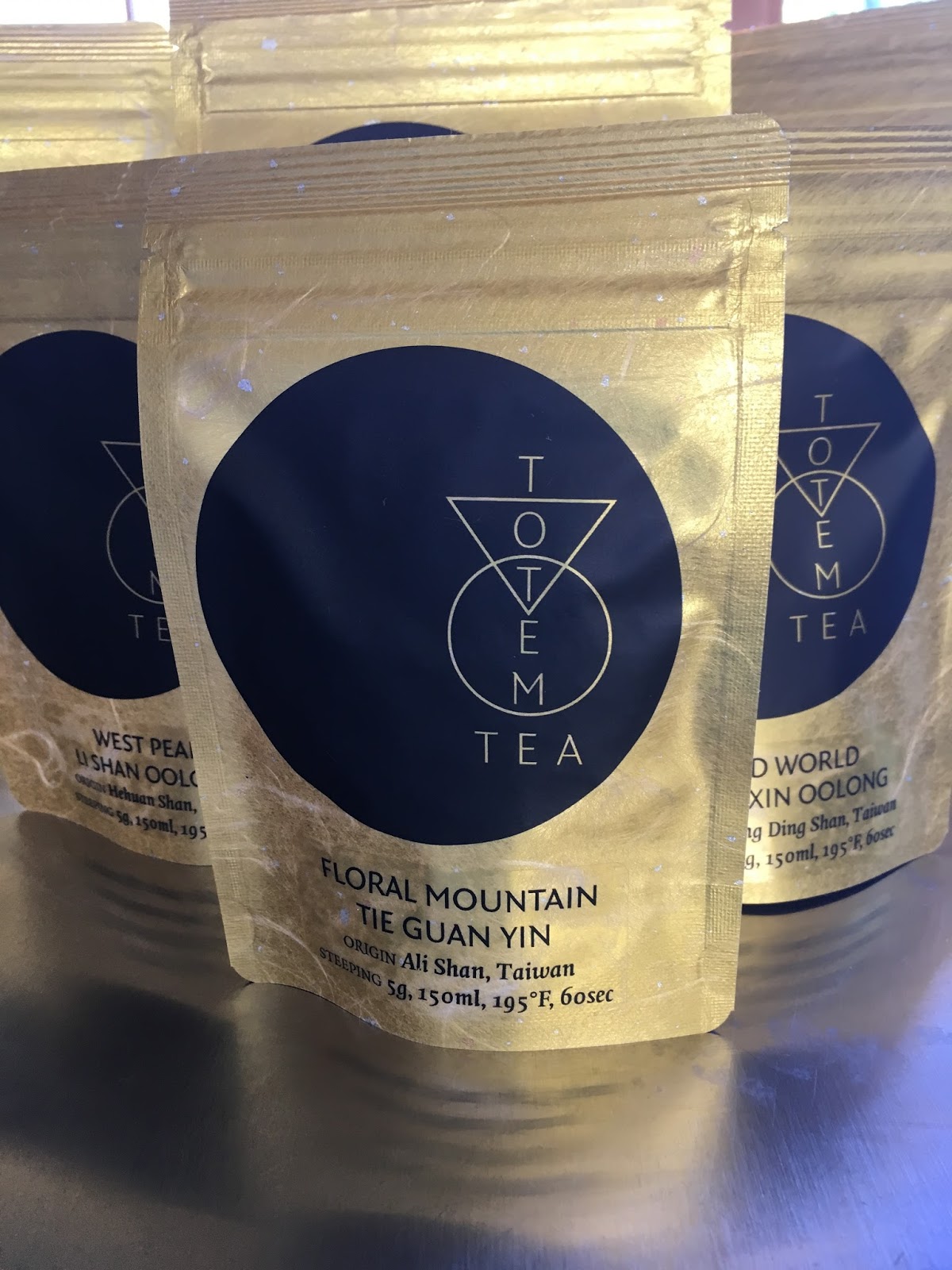
All very good teas! I was particularly drawn to the Floral Mountain Tie Guan Yin. I found this to be a liminal tea. It had the light, top notes of the modern, competition styles (Anxi, greener) but with a depth of roasty groundedness (more like my preference, Muzha style). Another point of interest for this tea - it hails from Ali Shan.

Now let's talk incense.  I used to avoid it. It made me sneeze or gave me a headache. Then I discovered the amazingly delicate pleasures of Japanese incense. I was hooked, and my love of incense has grown. Finding the type of incense I appreciate isn't an easy thing from the US, and I'm delighted to recommend Phillip's line. He's got some really nice incense here, folks.


I appreciate the well-curated line of teas and incense from Totem Teas. Buying teas via the internet is always a risk - you don't get the benefit of sampling. What I can say is that you're in good hands with Phillip's choices.  


Sunday, September 11, 2016

Sample High Mountain Taiwanese Oolongs, Floating Leaves Tea


Shiuwen Tai, Floating Leaves Tea

Keep reading to the bottom of this post for a 30% discount on the High Mountain Oolong Sampler box from Floating Leaves Tea!

I am blessed to be able to taste teas regularly with Shiuwen Tai, of Floating Leaves Tea. Shiuwen's shop specializes in well-curated teas from her homeland Taiwan, as well as China and Japan. I had the chance to travel to Taiwan with Shiuwen in 2013, visiting farmers and fields and drinking my weight each day (or so it felt) in tea.  It was heaven!

Below is evidence of a recent tasting, where we made our way through several categories of tea, including white, baozhong, high mountain oolongs and Ti Guan Yin. 


Shiuwen gave me a sampler box of High Mountain Oolong teas, to taste and write about. This is a new product available from the online shop.  Shiuwen has very generously given readers of my blog a 30% discount for the next 30 days on the High Mountain Sampler, shown below.  This is a very, very good deal!!  Use "stephcupoftea" in the referral code at checkout.

The sample box contains a half ounce each of Alishan, Shan Lin Xi, Li Shan, He Huan Shan and Da Yu Ling. The teas represent different mountains (and elevations) in the category of High Mountain Oolong.  

I recommend using two gaiwan and tasting these teas side-by-side, so that you can tease out the subtle differences.  (You can steep these teas several times each, so this is a great thing to do with friends.) While this category of tea, generally, is light and aromatic, when you drink these with attention and care, you will be given the gift of noticing the differences in flavor, aroma and mouth feel. 

So let's celebrate a good deal and good tea!  Thank you, Shiuwen.  Go here to enjoy the discount (good for next 30 days) and use "stephcupoftea" in the referral code.  

Friday, April 03, 2015

ShanLinXi Oolong (Taiwan) and Poetry


April is National Poetry Month. I love poetry! I'm regularly moved deeply when reading or writing poems. I think truth is often best known through a poem, and it takes a brave person to write the truth. And so, I will strive to sprinkle poems liberally throughout my postings this month. Also, plan now for National Poem in Your Pocket Day, April 30th!  It's a fun day that I get giddy about each year.  

This spring finds me busy with work, home and tea life and in addition, planning for a service trip to Rwanda.  I look for frequent ways to bring calm into my life. Tea is always a remedy, as this poem explains:  

"Though I cannot flee
From the world of corruption,
I can prepare tea
With water from a mountain stream
And put my heart to rest."

~Ueda Akinari, 1734 - 1809, Japanese author and waka poet


I recently  had a few hours on a sunny afternoon to drink Winter 2014 ShanLiinXi tea from  Floating Leaves. It's a tea that's very balanced and I appreciate the fruity aftertaste.


I had the good fortune to drink this tea with Shiuwen Tai (of Floating Leaves), and she is helping our tea group appreciate the nuances of teas like this.  In addition to the aroma and taste, we spent time paying attention to the tea broth and how it feels in the mouth.  This tea was described as "creamy" for the way one experiences the feeling of the tea (not the flavor).  


The next time you're drinking an oolong tea, spend some time with the mouth feel.  Is it thick or thin? Does it coat your mouth? Does it leave your mouth feeling dry? Try not to judge, but rather experience and notice.


This burlap fabric, above, is from my China-adventures roomie.  I LOVE it!

This cute little guy was my tea companion.


Notice how much the leaves have expanded.  I used a layer of the dry, balled tea to cover the bottom of the pot and when done brewing, it filled the pot up.

OK, your turn!  Share with me your thoughts on poetry or this poem, on how to appreciate tea, on mouth feel, or on whatever you feel moved to share.

Tuesday, February 24, 2015

Sweet Tea, My Version


I recently enjoyed (on Valentine's Day) this sweet tea time with my DH, dear hubby.  We drank an aged Taiwanese oolong tea.  Sweet tea, a little different.  :-)


Tuesday, December 16, 2014

Drinking SE Asian Teas


How fortunate I am to have friends that love tea AND that travel to far away places and bring back teas to try!  I recently had the chance to taste tea from Southeast Asia, specifically Laos and Burma.


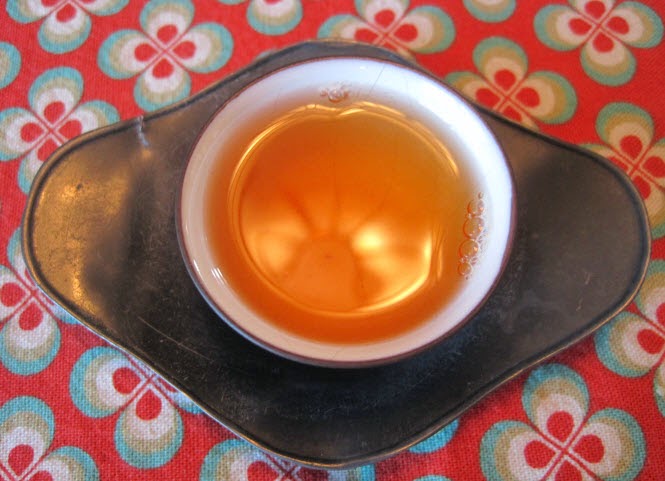
The Laos tea was from an "old tree."  We think that means no one knew exactly when the tea tree was planted.  Maybe it went rogue, but now it's being harvested and processed into black tea.  It brewed into this lovely copper color shown above.  I enjoyed this tea very much.


Piglet gets muddy


The Burma tea was a "pu-erh" in the shou (ripe) style. This tea brick was purchased from a local company, Tao of Tea.  As you can see, it brewed into a rich chocolate color.  Look closely to find the steam floating on the surface of the liquor.  

As we sipped, we reviewed a map to see exactly where the countries that produced these teas were in relation to Yunnan, China.  Relatively close, which makes for an interesting consideration of tea flavor profiles and processing techniques.  I love learning about the world through tea!

Thursday, September 04, 2014

Bat Brew


I was brewing some tea with friends in a park last evening, in a quiet clearing circled by tall pine trees.  It was dusk and the light was fading. (The mosquitoes were making themselves known.)  My fellow tea fanatics and I heard this rustling noise above us and spotted bats flying overhead.  Soon, we could hear their clicking sounds (they were using "echo location") and an occasional squeak. It was so cool!  After about 5-10 minutes of this other-worldly show, they disappeared.  As my DH recently said, "Nature participates."  Yes, and in very cool ways!

The photo above is of the brewing session.  We're drinking a tea from Global Tea Hut.  It's a "Kingfisher Jade" - Tsiu Yu - hybrid that was developed in Taiwan, one of the "Three Daughters of Taiwan." I liked it very much. It's a lighter oolong, on the greener side but not without some depth.

Monday, April 07, 2014

The Stronger Pull


"Let yourself be silently drawn by the stronger pull of what you really love."
~Rumi, 1207-1273

I could have cleaned the office, folded the laundry or washed the dishes.  Instead, I made tea.  A far-away but near-in-heart  friend had sent some Fenghuang Shuixian.  I wanted time to taste this tea, sit alone with it and write a long letter to this friend. 


Delicious tea made exquisite by the moment.


Though I drank alone, I poured two cups: One for me and one for my friend.  I love that tea can connect us at the heart level when we open to it.

PS - Happy National Poetry Month!  Each post this month will include a poem.

Friday, August 30, 2013

Tea and Cheese and Passions


One of my favorite experiences is to be around people who have imersed themselves in their passions and then share that with others. The topic hardly matters; being with someone who knows and loves the topic is a joy.  When that topic of passion corresponds with mine, well then it's super!  Just like last weekend...

I had the good fortune to attend (with Marmalady) a cheese and tea pairing, hosted by two local experts.  Steven Smith and Steve Jones.  Smith is prominent in the tea scene, having been part of the birth of both Stash and Tazo brands, and now runs his own tea company. Jones is not only a skilled and thoughtful cheese seller, but also a national cheesemonger champ.  The two Steves decided to join up to share their knowledge and passions.
The pairings were carefully selected, the idea to bring out the best in both the tea and the cheese.  We enjoyed, starting at noon and working clockwise on the plate:

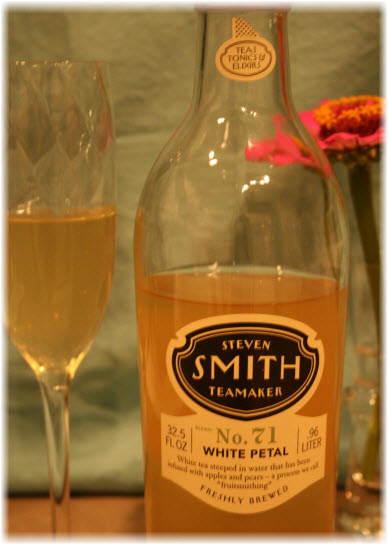
1:  Tea - White Petal (No 71), a white tea with chamomile, osmanthus, pear and apple infusions (for citrus) and lightly sweetened, from the Ready-to-Drink (RTD) bottled line, served cold; Cheese - A goat's milk gouda, aged 6 months
2:  Tea - Lord Bergamot (Smith's take on Earl Grey and his #1 selling tea); Cheese - an earthy Montgomery English cheddar
3: Tisane - Red Nectar (rooibos and honeybush); Cheese - Gruyere de Savoie, a French cheese, lightly creamy and nutty
4: Tisane - Big Hibiscus; Cheese - Aged (2 years) cow's milk gouda with a nice crunch due to caseins that crystallize in the aging process
5: Tea - Brahmin (a blend of Assam, and two Ceylon teas); Cheese - Lightly smoked sheep's cheese from basque Spain (Idiazabal)

The pairings exceeded my expectations!  I didn't know if I would find tea with enough acidic "bite" (thinking of wine) to go well with the cheeses. Wow - some of them had just that and the others showcased the cheese's creaminess. 

I learned a lot, too.  For example, these designations relate to cheese: 
Farmstead:  The milker is the maker, cheese made at the farm where the animal is milked
Artisanal:  Hand made cheeses, small batches (this has an actual meaning in the cheese world, vs. a marketing label)
Coop:  Pooled milk from a region, 1 great cheese maker

Have you ever enjoyed a cheese and tea pairing?  What pairings would you like to try? 

Thursday, October 18, 2012

Tea Cupping Part II: Country of Origin

A nice set of oolong teas, ready for tasting
(courtesy the group to my right during our class)

A few days ago, I wrote about the International Standard of tea tasting.  Now let's break those rules.  ;-)  In the Advanced Tea Tasting class at the NW Tea Fest, we took a look at country-of-origin methods of tasting and grading tea. 
Oolong teas, from light to dark

The International Standard is useful for doing business across country (even continental) lines.  At the same time, within the tea-growing regions, tea farmers and business people use local methods of tasting teas.  These local methods take into account the unique properties of the tea from that region. 

For the oolong tea cupping, the procedure was very simple.  We used what Suzette called "Farmer's Style."  The dry leaf, 7 grams, went into the open bowl and we filled it to the top with boiling water.  We used a porcelain spoon for tasting.  (Porcelain doesn't interfere with the taste or aroma.)  Here's a good tip I learned:  When breathing in the aroma, breathe in with both your nose and mouth.  Then turn your head away from the tea to exhale, out of politeness for the others.  We started tasting at about 5 minutes and kept tasting further along.

We also did a second cupping using the full tea cupping set (Internatioal Standard) and performed what we called "Patience Testing."  That's to test the multiple infusions and see how long the tea would continue giving. 

Now onto Japanese greens...

Japanese Sencha
For the Japanese sencha, we used 4 grams of tea in a mesh filter in the open cup and poured hot water to the top.  At about 1 minute, we lifted the screen to enjoy the aroma, then put it back.  At 1.5 minute, we removed the screen.


See the heart?

Cloudiness in the Japanese green teas is desired.  The particulate is added back during the processing.  We only did one steeping here.  The Japanese senchas are meant to be consumed promptly after drinking.  They don't sit well, and there's no expectation of multiple infusions, like with the oolongs.

----
Tea is so fascinating to me!  I feel like I've stumbled into the best-kept secret ever.  I've found a fascinating topic that will give me a lifetime full of pursuits!

Tuesday, October 09, 2012

Tea Cupping Part I: International Standard

International Standard Tea Cupping Set

"Tea cupping" is the phrase used by professionals to taste and evaluate tea.  Common characteristics that are judged include the flavor, of course, but also the look of the dry leaf, the aroma, the color of the liquor and the look of the wet leaf.  I've had the great good fortune to sit through several tea cupping seminars, starting with Tim Grafton in London, several times on the Asia Tea Tour and then for the past two years with Suzette (Rishi Tea) at the NW Tea Fest.

The International Standard is:
  • 3 grams of tea
  • 150 ml (~5 oz) boiling water
  • 5 minute steep
  • Here's a great video for the mechanics of it!
Dry leaf, liquor, wet leaf = the ingredients to make an evaluation of the tea

Consistency is super important here. Each tea you are comparing must be treated in the same precise manner. "But 5 minutes for a green tea?!" you might justifiably exclaim! Yes, it's true, as an industry, we've finally gotten traction when it comes to educating people to brew different teas at different temperatures.  Why now break this rule?  Because professional cupping has a very different purpose than drinking for pleasure.  (Please keep brewing those greens with cooler water for your home enjoyment!)

The Differences  Professional tea tasters have well developed palates that allow them to notice subtle differences between teas.  Those differences are what the taster is after.  S/he compares many similar teas side-by-side.  Perhaps it's a blind tasting that compares different vendor's teas for selection.  Or perhaps it's at the tea farm and samples of the same tea varietal are being tested from the same harvest, the only difference being the location of where the samples were grown.  By "pushing" the tea, meaning treating it to a very long and hot soak, the subtleties shine through.  Likewise, any weaknesses in the tea become apparent.

Do Try this at Home!  Have you ever tried tea cupping?  If you get the chance to do so, it's very fun!  And just because the International Standard is as described above, it doesn't mean you have to buy the fancy equipment.  For your personal tasting, the most important factor is to be consistent.  Pick two or three teas to compare (maybe three black teas, for example), and find brewing vessels of the same size.  Use the same amount of leaf, same temperature and volume of water, and brewing time and see what you think!


Friday, September 07, 2012

Reader Tea Reviews: Paisley Teas

A very special thank you to my blog readers who joined me in a review of new Paisley Tea Company products!  Fanfare and gratefulness for Esmerelda (and friends), Ginger, Judy, Linda, Marmalady and Snap!


English Breakfast photo courtesy of Snap

We approached the reviews in unique and diverse ways, and this is what I enjoyed most.  I loved learning about the way each woman approached her review.  Some did so systematically, observing water temperature and time.  Another shared the tasting with her husband.  One woman gathered a group of friends and hosted a tea party.  We have a review from a pre-schooler, too.  All reviewers did an excellent job! 

The teas we reviewed were in bags, organic and Fair Trade.  Paisley Tea Company's parent company is Two Leaves and a Bud. Thank you to Paisley Tea Company for providing the samples for this taste test.

You'll notice differing opinions among the reviewers.  Isn't it cool how we can disagree and still appreciate each other's perspectives?  (A fact not to be lost in this election time!)  Here's what we thought...

English Breakfast
"It is a lovely dark golden brown in color [3 min brew]. I found the flavor to be strong with just a little tang. Remember, I'm a green tea fan so this just may be my taste buds waking up! I then added a little lemon (my usual) and found the tea very nice. A good wake up call for breakfast....  I tried another cup later in the morning. Preparing the water in the same way, this time I let the tea steep for 5 minutes. I didn't find much difference in steeping 2 minutes longer. Perhaps a small bitter after taste. It is hot here and I thought "let's try it iced"! It was okay. I added a little *fake* sugar and my usual lemon. I have to admit I enjoyed hot English Breakfast Tea more than the cold."

"Smell of the bag was virtually nonexistent. The tea brewed to a lovely dark brown with a very mild and light taste and smell. This would be a good tea for people that don't like strong tea. This was not what I've experienced with other brands of English Breakfast teas."

At a tea party..."We found it smooth and not as astringent as most English Breakfast Teas.  K thought it a bit bitter (I only steeped it for about two minutes...  I used 4 [teabags in the pot] so two minutes seemed plenty)."

"My husband and I did our tea tasting and review.  Now this was done with a man; therfore, it was bare bones and quite serious.  He did as a parofessional tea taster would do.  It was fun...  All the teas were brewed with boiling water at 5 minutes.  Each tea was served in its own different cup.  I used a tea cup and my husband used his mug.  They were white inside so we could see the color of the tea...  English Breakfast:  Dark amber color.  Very, very faint tea aroma, more body in this one, made my mouth pucker - stronger briskness.  B detected a slight lemony taste, more brisk aftertaste.  After addition of clover honey, it cut through the brisk taste."

   
Decaf English Breakfast

"We had T (pre-schooler) taste the decaf.  She loaded it up with honey and milk and proclaimed it delicious." 

"This tasted very similar to the regular English Breakfast tea. This would be a good choice for people who want Decaf but want the flavor of regular."

"Decaf English Breakfast and English Breakfast:  I tried one cup of each of these teas side by side to compare.  They were brewed in boiling hot water for about 1 minute.  I found the regular English Breakfast to have slightly more fragrance, but flavor was very close to the same.  I found them both rather nondescript and weak.  ...Second try:  Brewed for 4 minutes each with about half the amount of boiling water.  The regular English Breakfast became a bit too tannic for my taste, but the Decaf actually was a bit better.  Not a tea I would buy as the flavor just wasn't clean enough."

"Rich amber color, faint aroma/weak in tea fragrance.  Not a full-body tea, pleasant aftertast, slightly brisk.  B uses honey in his tea usually so after the fist sips he put honey and found he tasted a more brisk impact than before.  Not a very clear tea for some reason."
    

"...big thumbs up on the English Breakfast and Decaf English Breakfast..."

Green Ginger
You can also read Snaps review of the Ginger Green tea here.

"Pretty yellow color; ginger frangrance but now overpowering.  Somewhat flat in flavor, no briskness, medium body.  Addition of clover honey masked the ginger flavor.  We don't normally drink Green teas.  We like the fullness of black teas, so this was really new to B!"

"I let the water cool a bit (tried to do the 160 thing) and put three tea bags in the pot. I let it steep for about three minutes until it was a thick amber color.  None of the three of us could taste  the ginger. It was more like a green tea. It had a vegetable kind of taste and aroma.  A thought it smelled and tasted somewhat like Green beans."

"...Second two teabags I made with boiling hot water and a little less water. I did find more interest in it made with the higher temp, but still didn't taste much ginger.  On both of the tests I did find that the green tea wasn't too grassy, which is something I don't like in a green and for that it made it easier to drink. Didn't notice an after taste. Both tests were steeped at 4 minutes."

"The tea was a pleasant light amber in color and had a slight grassy/ginger aroma. I let the tea steep for 3 minutes.  ...Unfortunately, I compared it to a matcha with ginger I had recently and [this tea] couldn't hold a candle to the matcha."

"...smell of bag and brew was of ginger. The tea brewed a lovely yellow green color and the taste was light but of ginger. When I was pregnant I would have enjoyed this tea because of the properties of the ginger and the fact that it was green. I normally drink green tea everyday, usually sencha. This was my favorite of the 3 teas."

Wednesday, April 25, 2012

Korean Tea - Korean Noodles

I've been enjoying a Korean green tea generously shared by my tea friend Karen.  Alas, I have no photos, but see her beautiful ones here.  I agree with Karen's advice to brew this tea like a Japanese green, at a low temp (about 160 degrees).  It's refreshing and bright.

Thanks to another friend, we recently discovered a delicious Korean restaurant, Du Kuh BeeIt's a tiny spot and if you arrive late on the weekend, you may have to stand in line outside for one of the few tables.  The wait is worth it for the kimchi and hand-stretched noodles!

Pickled daikon radish and kimchi

Hand-stretching the noodles


The finished dish, so yummy!

Have you tried Korean teas or food?

Thursday, April 19, 2012

2012 First Flush Darjeeling and GIVEAWAY!

Happy dance!

Giveaway Alert - continue to the bottom to read details!

Last Friday was a special day! My first flush Darjeeling tea arrived.  I'd only ordered it the week before, and I was impressed with the speed of delivery.  I ordered from Thunderbolt Tea, and I am very pleased with the service.  I was kept informed of the order at all times and have been delighted with the teas!

I ordered the Turzum and the Sungma teas (both classic first flush processing).  I also received a surprise sample of the Arya Pearl (a white Darjeeling).  All three are certified organic.


I practiced amazing restraint, saving the first tasting to enjoy with some of my Wu-Wo tea friends.  We decided to brew using my cupping sets.  (The scenes are of tea traveling via wagon and locomotive, and on the sideways cup, tea auctions.) 

I've had first flush teas before, but never this closely to having been picked.  The look of the leaf (both the Turzum and the Sungma) was much greener than I expected.  I brewed the teas at a couple of different temperatures and lengths, but generally cooler than normal, about 190 degrees Farhenheit, for about a minute and a half.  Water boils at a lower temperature in Darjeeling, and I was attempting to replicate those natural conditions.

The aroma, for me, was very much like freshly-cut alfalfa hay.  Sweet and enticing.  I grew up around hay fields, and so this immediately came to mind.  The DH (also a Midwesterner) had the same thought, even though we hadn't discussed it. 

Both teas are excellent, worthy of time and attention, to be consumed with focus and appreciation.  Our tasting group fell particularly in love with the Turzum tea, though I don't mean to slight the Sungma in any way!  Tasting friends - what are your thoughts?

My tea plant


My own tea plant is flushing right now, see the downy filaments on the baby leaf?

GIVEAWAY!
I'm going to share samples of my first flush teas with one lucky winner!  To enter (and in recognition of National Poetry Month), leave me a haiku poem that has the words "first flush" included somehow.  I'll draw a winner next Thursday, April 26th.  Here's one to get you started. 

Hush.  Tea leaf unfurls.
First flush, the springtime glory;
Listen to the tea.


Thursday, April 12, 2012

Locally Bottled Beverages

Rose Secret:  Includes Rose Water, Sugar, Citric Acid

I recently tried a new Oregon-made beverage called Rose Secret.  It was tart, lightly sweet with rose scent and flavor, nicely balanced - no part was overwhelming the other.  This experience got me to thinking about the numerous locally-brewed and bottled beverages - and I'm not just talking tea!  For those of you that don't know, Portland is the micro-brew beer capital of the US.

So now let's focus on tea...here are some of the locally-brewed treasures:

The Tao of Tea has a line of micro-brewed teas and tisanes.  I'm really enjoying the bottled Tulsi's, a caffeine-free herbal infusion.  You might have heard it called holy basil. 

Tao of Tea line of bottled Tulsi*

Steven Smith has recently released a bottled tea beverage using local fruits to provide the citric acid (necessary for shelf life).  Plus, the bottle is gorgeous!

Steven Smith bottled tea


I recently sampled the Pomegranate Love kombucha from Lion Heart.  I wasn't sure what to expect, the pink color seemed almost surreal and yet it is a natural blend of pomegranate, white and green teas.  I liked it!  A friend also recommends the Ginger Fizz, and she's not even a kombucha fan.  I like to drink kombucha as an after-dinner digestive, a small cup goes a long way.

And there are many others:
What other local brandsd have I missed?

*Photo from vendor website