Showing posts with label Green Tea. Show all posts

Tuesday, May 30, 2023

Green Tea Sports Drink


Ingredients: Organic green tea, honey, sugar, salt, lemon and (not shown) coconut water

 Hello!  It's been a loooong while since I've posted anything. A lot of life has happened since, and I'm also posting frequently on Instagram @stephwtea. But here I am with a bit more time on my hands, planning to share occasional musings on tea and life here once again. (Are blogs dead? Possibly - still, I write.)

I've transitioned out of my 25-year corporate career. So what have I been doing? Walking - a lot! (Plus cocooning and putting the foundation in place for my work going forward.)  Back to the walking - I turned 50 earlier this year and I want to mark the milestone year with something physically challenging. I decided to hike, in one day, a well-known trail in my region that happens to be about 50 kilometers (31 miles). I've been training since Dec 30th, my last day of work. 


The color is all natural, from the tea and lemon juice

It's been fantastic! And a LOT of miles, which brings me to the subject of this post. I don't usually do sports drinks for two reasons: 1 - I think they're over-utilized in general and 2 - I don't like the flavor of the commercial ones. And yet, once I got up to 4+ hours of hiking, I needed something in addition to water. My heartfelt thanks to Jenna Braddock for the original version of this recipe! Jenna is a dietitian and personal trainer, and determined what was necessary to make a balanced drink in terms of sugars and electrolytes. Deep gratitude! I took the original recipe and customized just a bit, reducing how much is made and upgrading the quality of tea to loose, organic green. (I'm using the Young Mountain Tea Darjeeling Green.)


Field testing: a winner!

Here's my version of the recipe, if you'd like to give it a try. It makes just a bit over 2 cups.
  • In a heat-safe vessel, pour 1 cup of boiling water over 1 generous tablespoon of loose green tea. Steep for 4 minutes. (Important note: This is a very rare moment when I will suggest you use boiling water on green tea, and for this long! Usually, it's a shorter steep and much cooler water. Here we're making a concentrate.)
  • Remove the leaves after 4 minutes.
  • To the hot tea, add and stir until dissolved:
    • 1 TBSP of honey (fructose and glucose)
    • 1/2 TBSP (aka teaspoon and a half) of table sugar (sucrose)
    • 1/8 tsp salt
  • Let the tea mixture cool a bit, then add 1 cup coconut water and 1/4 cup lemon juice
  • Chill and then enjoy out on the trail!  (I usually make this the night before.)

Sunday, June 05, 2016

Cooling the Water


It's HOT here in the Pacific Northwest.  We've had temps hovering around 100 degrees for three days. That's intense - especially for June and for a region where a fair number of folks don't have air conditioning. 

In these hot temps, I still drink hot tea. I choose teas that do best with cooler waters, often greens and especially Japanese greens, like sencha (ironically, in the photo above, I'm not drinking a Japanese green).

There are several ways to cool the water: Take it off the heat before it reaches a boil, let it sit off the boil before using, or - as shown above - use a cooling pitcher. The cooling pitcher (yuzamashi) is a common feature in sencha sets (also in Korean tea sets).

I'm not using a thermometer, so I'm guessing at the temperature.  I sense that it's cooled to around 160 degrees.  After pouring the cooled water into the pitcher, I generally pour off at about 30 seconds, adjusting on the second brewing, as appropriate (usually a wee bit longer).

I confess: I've brewed some senchas really poorly, and more times than I care to admit.  It's always because I've been distracted. This is a tea that requires your full attention.

Below: I'm decanting straight into my teacup, but it's also possible to use the water cooling pitcher as a serving vessel.  Note that the tea will continue to cool in the wide-mouthed vessel, so at this point (the tea is done brewing), you want to serve quickly.


You don't need anything fancy to cool the water.  You can even use a Pyrex measuring cup.

Experiment and find the right process for making yourself a great cup of green tea with cooler water.

Thursday, August 28, 2014

Summer Flash


Summer is starting to give way to fall here and it's promising very nice weather this long weekend!  Sunshine and mid-to-upper 70's. I think of this as summer going out with a flash of glory as fall nudges it along.  I'm drinking a Japanese green tea in these photos, feeling a sense of urgency to drink up my "summer teas".  Of course I can (and do) drink this in the winter, and yet it's more what I crave when the sun shines long. 


While my tea is green and fresh, the colors of these photos suggest a fall scene. These transitional periods are very interesting times.  I find them full of energy and opportunity.


What teas are your drinking as we make our way from one season to the next?

Sunday, March 03, 2013

A Japanese-Themed Tea Luncheon

Last week, I had the honor of hosting several women colleagues in my home for a tea luncheon.  Given my interest in all things Japanese these days, I decided to provide a Japanese-themed lunch.  New territory for me!

I used a combination of my own disheware with some items borrowed from a very generous tea friend (thank you JE!).  She also provided several Japanese cookbooks and suggestions of menus.  

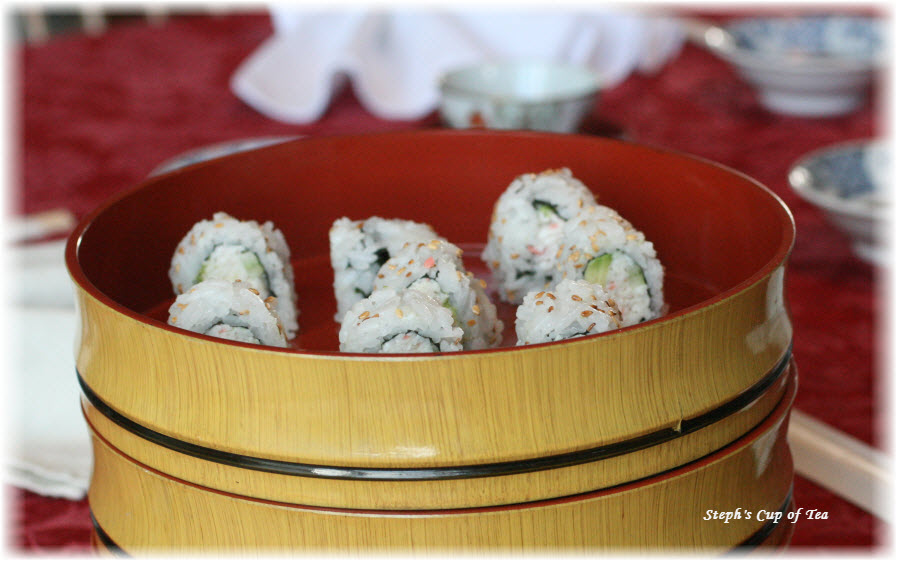
We started with yuzu spritzers, made from club soda and yuzu syrup.  Then we moved onto lunch.  We enjoyed green beans that had been blanched and dressed with a mixture of soy sauce, sesame oil and agave (I made this one up) and sprinkled with sesame seeds and seaweed.  I purchased a few rolls (California, avocado and cucumber) from the sushi shop down the street. I kept these vegetarian and cooked (the California roll is cooked crab meat) because not everyone loves raw fish. 


I also made Japanese pickles, and I was delighted with these!  We'll definitely be keeping these around in my household. These are better know as "refrigerator pickles" by my Grandmother, meaning they're fresh and not heat-processed.  The pickling solution includes sugar, white vinegar, water and mirin (a cooking sake).

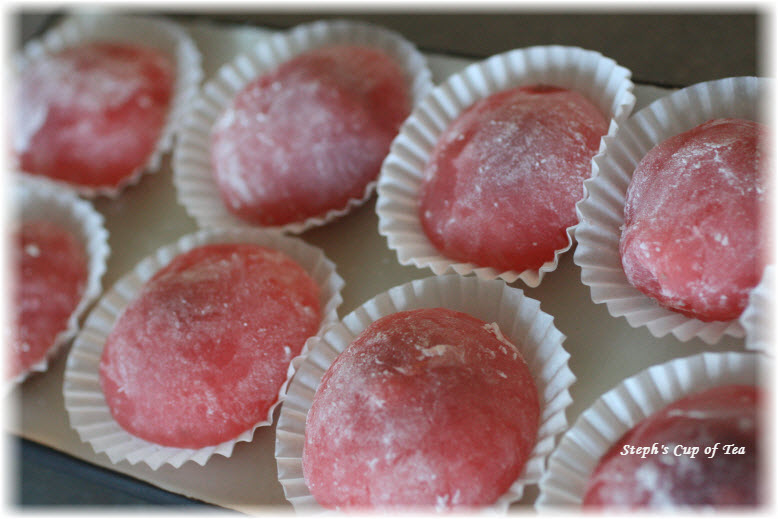
For dessert, I gave my friends a chance to try mochi.  These sweets had a chunk of strawberry in the center, wrapped in red bean paste and covered with a sweet rice flour dough.  They're chewy and sticky and I like them.  My friends were all very good sports!  (We also had Rice Krispy treats.)
I very much enjoyed the planning of the event, and of course spending time with my friends!  Interestingly, much of this menu is vegan and gluten-free.

Friday, February 22, 2013

Genmaicha on a Rainy Day


I've just come in from the rain + wind + cool.  What a welcome sight, this plum tree branch and my small tetsubin pot (enameled, not traditional) full of steaming genmaicha. 


Genmaicha means brown rice tea.  It's sometimes called "popcorn tea" - you can see why. ;-)  The puffy kernels are actually roasted brown rice that has popped in the roasting process.  The green tea is typically sencha.  The flavor is nutty and savory, almost like a broth.  It was the perfect tea to warm my bones today.

Do you have a favorite tea to drink on a cold day?  Have you had genmaicha?  Do you like it?

Tuesday, January 29, 2013

What is Green Tea?


Chinese Huangshan Maofeng tea
Photo taking during the
Asia Tea Tour

Green tea is diverse!  From sweet to tart, mellow to brisk, nutty to roasty, grassy to vegetal, twisted to flat to rolled to hand tied, I believe there is a green tea for everyone.  Truly, there is an entire world of green tea for you to try!  The fun comes in finding the ones you love.

The two basic categories of green tea are Chinese and Japanese, though you'll find most tea-producing countries making green teas.  In fact, it's green tea that most of the world knows, loves and drinks.

Chinese Green Tea
China has been producing green teas for over 5,000 years!  Chinese greens are a good place to start if you're just venturing into the world of green tea.  They're milder, sweeter and less likely to make you pucker on first sip. 

Chinese green teas are picked and then heated to stop the oxidation and preserve the chlorophyll.  (This process is called "fixing"  the tea.)  There are myriad of ways to fix the tea, but common techniques include heating in a wok, in bamboo baskets over charcoal, or in heated ovens.  The amount of variation within Chinese green tea is staggering - taste, appearance, aroma.  There are thousands of small batch tea makers, each with his or her own technique.  

Famous Chinese green teas include:  Dragonwell, Gunpowder, Bi Lou Chun, and Huangshan Maofeng (shown above).

 
Chinese Beauty Rings
An example of beautiful hand shaping


Japanese Green Tea
Japanese green teas are well known for the bright jade liquor produced in the cup, with a bit of sediment at the bottom.  This sediment is intentional, nothing is wasted.  The particulate is added back into the leaf to give it a brothy essence.

Japanese greens are steamed to fix the leaves and then shaped (this can have several cycles) and finished in a hot oven.  Most of the picking and processing of teas in Japan is mechanized.  Don't let that turn you off; it's just how it's done in Japan. 

Famous Japanese green teas include:  Sencha, Bancha, Gyokuro and Matcha.  (We'll look at matcha separately.)
Japanese Sencha

Japanese Bancha

Many Chinese and Japanese greens never make it to our shores.  They are swooped up by local consumption, and increasingly, in-country connoisseurs.  But don't despair - there are many, many available to us and if you tried to taste them all, you would find a major undertaking! 

Buy green teas in small quantities and drink them up quickly.  They don't keep as long as oolong and black teas will, due to a higher moisture content.  I prefer to drink mine within 3 months ideally, 6 on the outside.

I tend to brew my green teas - both Chinese and Japanese - in a gaiwan, but you can also use a teapot.  Use water between 160 and 180 degrees, and start tasting quickly.  I find the window for most greens to be between 1 and 3 minutes.

What are your tips for greens?  Or your favorite green teas?

Thursday, October 18, 2012

Tea Cupping Part II: Country of Origin

A nice set of oolong teas, ready for tasting
(courtesy the group to my right during our class)

A few days ago, I wrote about the International Standard of tea tasting.  Now let's break those rules.  ;-)  In the Advanced Tea Tasting class at the NW Tea Fest, we took a look at country-of-origin methods of tasting and grading tea. 
Oolong teas, from light to dark

The International Standard is useful for doing business across country (even continental) lines.  At the same time, within the tea-growing regions, tea farmers and business people use local methods of tasting teas.  These local methods take into account the unique properties of the tea from that region. 

For the oolong tea cupping, the procedure was very simple.  We used what Suzette called "Farmer's Style."  The dry leaf, 7 grams, went into the open bowl and we filled it to the top with boiling water.  We used a porcelain spoon for tasting.  (Porcelain doesn't interfere with the taste or aroma.)  Here's a good tip I learned:  When breathing in the aroma, breathe in with both your nose and mouth.  Then turn your head away from the tea to exhale, out of politeness for the others.  We started tasting at about 5 minutes and kept tasting further along.

We also did a second cupping using the full tea cupping set (Internatioal Standard) and performed what we called "Patience Testing."  That's to test the multiple infusions and see how long the tea would continue giving. 

Now onto Japanese greens...

Japanese Sencha
For the Japanese sencha, we used 4 grams of tea in a mesh filter in the open cup and poured hot water to the top.  At about 1 minute, we lifted the screen to enjoy the aroma, then put it back.  At 1.5 minute, we removed the screen.


See the heart?

Cloudiness in the Japanese green teas is desired.  The particulate is added back during the processing.  We only did one steeping here.  The Japanese senchas are meant to be consumed promptly after drinking.  They don't sit well, and there's no expectation of multiple infusions, like with the oolongs.

----
Tea is so fascinating to me!  I feel like I've stumbled into the best-kept secret ever.  I've found a fascinating topic that will give me a lifetime full of pursuits!

Wednesday, July 11, 2012

Sencha Tea Set


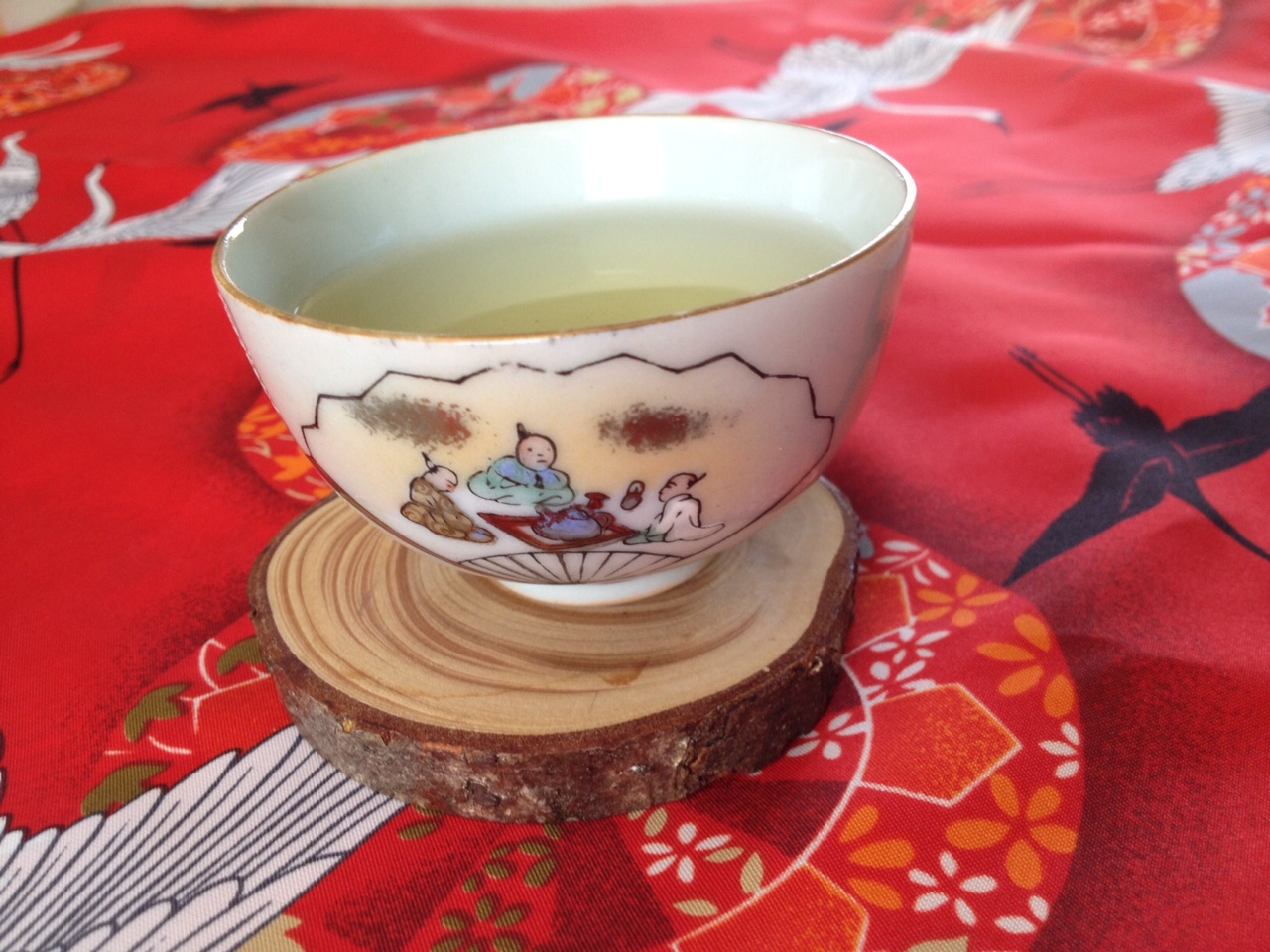
Hand-painted with motif of people making tea

This tea set has a story.  My friend J, knowing I've been studying Japanese Tea, sent me the eBay link.  It was a great deal, but I  was away on business travel and didn't have the mindspace to consider this.  It sat for two weeks, I didn't make an offer, and J bought it!  ;-)

FYI - The little pitcher vessel in front (above) is used to cool the water before brewing.
The complete set

J pulled it out at a recent tea gathering. Turns out the seller had been in our own back yard!  I loved the set, of course, and was regretting that I had let it slip, but happy that it came to a friend.  That friend kindly offered for me to buy the set...and so now it's mine.  (And she can use it any time she wishes!)   
Lovely sencha

I also had the chance to sample some delicious sencha teas with another tea friend.  Thank you!  Look at the gorgeous green.  See the sediment in the bottom?  That's desirable.  Japanese tea makers add back in particulate matter.  In this style of tea, it augments the flavor, look and body of the tea and wastes nothing.

Monday, July 26, 2010

Harney & Sons Tea Tasting: Bancha


Bancha tea is an everyday green consumed widely in Japan.  Bancha comes from the same plant as Sencha tea, however it is picked in a later harvest.  This later harvest makes for a lower-grade tea.  Even within Bancha, there are a number of grades.

Bancha is made with both leaf and twig, which you can see in the picture above.


I wasn't expecting to enjoy this tea.  I prefer smooth teas.  Ones that are what I can only describe as "metallic" are not among my regulars.  However, I liked this tea just fine.  I drank several cups.  Mine came from Harney & Sons.  Not sure of the grade.


The wet leaf plumps up.  I steeped for 2 min at 175 degrees.


As Harney described, the liquor is bright yellow. 

All in all, this was a flavorful tea.  To read another review, check out Angela's.