Showing posts with label Tea Culture. Show all posts

Tuesday, August 25, 2020

100 Years of (some) Women's Suffrage, Tea and More to Do


My copy of the tea set used by Alva Vanderbilt Belmont,
commissioned to raise funds for the suffrage movement.  More info

This month in the US, we mark the 100th anniversary of the 19th Amendment, which granted some women (mostly white women) the right to vote. The hard truth is that it took another 45 years for women of color to be guaranteed voting rights with the passage of the Voting Rights Act. 

Tea was a fueling beverage for the women a century-plus ago, laboring for suffrage. As we note the hard-fought victory of the 19th Amendment, let us also drink in the bitterness of this tea -- that many sisters of color were unable to vote until 1965. And another 10 years for Americans whose primary language was not English. 1975 -- that's in my lifetime. A moment of silence to acknowledge these transgressions. And a commitment to work for social justice.  

Following the model set by women in the UK, US women met over cups of tea to strategize and proselytize.  One infamous moment: In July 1848, Jane Hunt invited Elisabeth Cady Stanton to her home for tea, along with Lucretia Mott, Martha Wright and Mary Ann McClintock. These women were impassioned, and the gathering led to the Seneca Falls Convention just 10 days later. 

Let us now name some of the Black Suffragists who worked hard for voting rights: Sojourner Truth, Daisy Elizabeth Adams Lampkin, Frances Ellen Watkins Harper,  Mary Ann Shadd Cary, Mary Church Terrell, Nannie Helen Burroughs, Ida B. Wells.  Latinx suffragists include: María Amparo Ruiz de Burton and Adelina Otero-Warren.  Thanking Indigenous/Native American suffragist Zitkala-Sa and the Iriquois model of inclusion. Gratitude to Chinese-American Mabel Ping-Hua Lee and Japanese supporter Komako Kimura, who came from Japan to march with women in New York.  These are just a few of the many women of color who were committed to the cause. 


The ingenuity of the suffragists impresses, still today. They used tea parties to educate others, enlist support and raise money. 

There were at lest two special brands of tea sold for the cause, Equality Tea being one. Given that tea packaging is fragile, little physical evidence of this remains. 

In addition to the tea set shown above, the National American Woman Suffrage Association sold a demitasse cup and saucer embellished with "Votes for Women" on a gold rim. 

Image left: courtesy the California Secretary of State
Image below: courtesy liveauctioneers.com 


By the way, I've just learned that in the US, the preferred term was suffragist (not suffragette).  Read more. 

I'm indebted to and inspired by these suffragist women. I continue to think about how tea can play a role in the work of social justice.


Susan B. Anthony and Frederick Douglas statue in Rochester, NY
"Let's Have Tea" by Pepsy Kettavong

Image from commons.wikimedia.org

Wednesday, January 08, 2020

Back to Glenburn Tea Estate


Woman plucking tea in Darjeeling

Thank you AM for snapping this photo!


A workmate pointed out that I used the word heaven three times in one sentence, as I was describing my trip to Darjeeling, India and particularly Glenburn Tea Estate. Beautiful tea fields, majestic mountains, ethereal mists, scrumptious meals, plenty of exercise and time for day dreaming, good friends (old and new), and of course -- Darjeeling tea! 


On the way to Glenburn, we stopped for a picnic next to a tea field.
The fogged-in field was other-worldly! 

The path to Glenburn is, quite literally, over the river and through the woods and up a mountain and through the tea fields. It's a winding, and towards the end, very bumpy journey. Along the way, you'll stop for a picnic in a beautiful scenic area. (If you're prone to motion sickness, as I am, take meds AND sit in the front seat!) The 3-4 hour journey is worth every minute. When you arrive, you'll be treated to a welcoming glass of lemonade and the kindness of the hosts and staff. 


Our first day there, we decided to relax and do a little exploring.  I requested a cup of tea and what arrived was Afternoon Tea with fried tea leaves, cake and cookies!


One of the best things about Glenburn is bed tea! 
Your wake-up call is a tray of tea, cookies and splendid views.


I had been to Glenburn once before and long wanted to return. This trip in early October was one of the most lovely experiences of 2019. Special thanks to my traveling companion AM, and the the staff of Glenburn!  Bertie, Audrey, Rudolph and team - you made us feel so welcome!

Me, taking a walk in the tea fields


Imagine plucking for hours on slopes like this! 
I have so much gratitude to the people who make our cups of Darjeeling tea possible.


The porch, where I spent many happy moments writing in my journal (and drinking tea)


We spent a morning in the factory, learning how the tea is processed and sampling the
Glenburn lineup


Dinner is a leisurely, multi-course event but always finished with chocolate and tea.

Somehow, I still slept soundly!


Bertie and Audrey (along with Rudolph, not shown) -- hosts extraordinaire!

It's heaven for me!

Monday, July 15, 2019

Chanoyu: What Have You Been Studying for So Long?


I have been studying Chanoyu, commonly referred to in English as the Japanese Tea Ceremony, for 7.5 years as of this writing. While my sensei considers me an intermediate student, in many ways I feel like a beginner. 

I'm almost universally met with a "Wow!" when I share that I've been studying for this long. And what most folks are too polite to ask is, "What's taking so long?" :-)  It's a fair question!

First, there isn't one "tea ceremony." There are many variations, based on numerous factors such as season, guests, occasion, utensils, location and much more. Also, the further into my studies I go, the more complicated and lengthy the procedures become.

Second, it's physically demanding! It's hard (at least for me) to sit on my knees for long periods. Add to that the need to walk in a specific manner, make each movement with deliberation, and rise gracefully from the kneeling position (with precious tea utensils in my hands). It takes practice, conditioning, and skill to make this all look effortless. There is much to be learned! 

Third, we learn about many Japanese art forms and much history as we go. This includes the art and craft of pottery, ceramics, iron, bamboo, calligraphy, lacquer, wood, incense, flowers and more. We learn and tell stories about the tea utensils and the people who have made them.

And finally, I've referred so far to Chanoyu, which means hot water for tea. The term Chado, or the way of tea, is another expression, one of great depth, used for tea ceremony. There are four grounding principles in the tea ceremony: Harmony, Respect, Purity and Tranquility. To me, Chado expresses the spirit one has when approaching tea ceremony with discipline, mindfulness and care, and when attempting to apply the four principles to life.

Like ballet or painting or writing, there are elements of both discipline and art that can be studied, practiced and honed over a lifetime. One of my favorite experiences of tea ceremony was when I was invited to a tea gathering in Nara, Japan a few years ago (as a guest of my sensei). We watched as women well into their 70s and 80s practiced tea, with their sensei being nearly 90. They moved fluidly through the steps of the ceremony and appeared to radiate with their love of tea. May I be so fortunate!

Friday, March 22, 2019

Whisking Matcha for Enjoyment at Home

Matcha in tea caddy

Hello and happy Spring!  I'm going to be writing a series on the "Japanese Tea Ceremony" experience, known as Chanoyu or Chadō (the Way of Tea). But before we dive into that, I want to share how you can easily make and enjoy a bowl of matcha at home. 

And when I say bowl, I mean just that! In this style of drinking matcha, each person gets their own bowl of tea. I'll be making thin tea, called usucha. It's the frothy kind and it's amazing!

It's important to understand that there are many different schools of Chadō, and each has its own way of making tea. There are differences in how to whisk, the desired frothiness, etc. And yet each produces a beautiful and delicious bowl of tea. The school from Japan that I am associated with is Urasenke.  My local school is Issoan. Even though the instructions below are not for a tea ceremony, the style I've learned will show through.

In the picture above, you see a shaped "mountain" of matcha in a traditional tea caddy. Below are the typical implements: a bowl, whisk, scoop, tea caddy and a water ladle. You will not need all of these things.


Traditional tools for making matcha

What you WILL need: 
  • A bowl with a wide enough bottom for the whisk to move freely. Something like a rice or cereal bowl.
  • A measuring cup
  • A mesh strainer
  • Teaspoon
  • Bamboo whisk 
  • Matcha 
I recommend two investments for home enjoyment of matcha: A bamboo whisk (chasen) and good matcha. A reputable source available in the US is Ippodo. Please be careful where you buy your matcha and do not use cooking grade. You are ingesting the ground-up leaf and the flavor is intensified. You want the good stuff for drinking. Expect to pay $25-30/canister for a decent matcha.  See this site for more options. Also, don't buy large quantities and store the canister of matcha in a plastic bag with the air pushed out, in the freezer. 

Utensils for making matcha at home

    Sifting matcha
To make your bowl of matcha:

1. Rinse your bowl with hot water, then dry it out.  This pre-warms the bowl and removes liquid that might cause the matcha to clump.

2. Place the mesh strainer over the bowl. Measure in a scant (less than full) teaspoon of matcha. Tap the strainer or use the back of a spoon to push the tea through. Straining the tea helps reduce lumps.

3.Now add between 1/4 and 1/3 cup of hot water, ~170 degrees Fahrenheit. Please do not use boiling water. When I remove my kettle from the heat source and take the lid off, it takes ~3.5 minutes to cool to the right temp.

4. Take your whisk and lightly press down any floating tea. Then move the whisk briskly in a straight up-and-down motion. (Other tea schools do this differently.)  See the video below. You do not need to press down hard on the whisk (that can break the tines). Placing your hand over the top of the bowl helps to steady it.

                                                                            5. Keep whisking until you see a thick foam forming.
                                                                            Keep going a wee bit longer.  Then move the whisk
                                                                            across the top lightly to pop any big bubbles.

                                                                            6. Set the whisk down and enjoy the tea! 
                                                                            Matcha is commonly enjoyed with a small sweet.
Notice how the foam gets thicker over time.  Keep going!

If your matcha froth isn't thick, try using a little more matcha, a little less water, or whisking a little longer.

Mmmm.. frothy, foamy matcha

Tuesday, February 27, 2018

Macau Tea Culture House

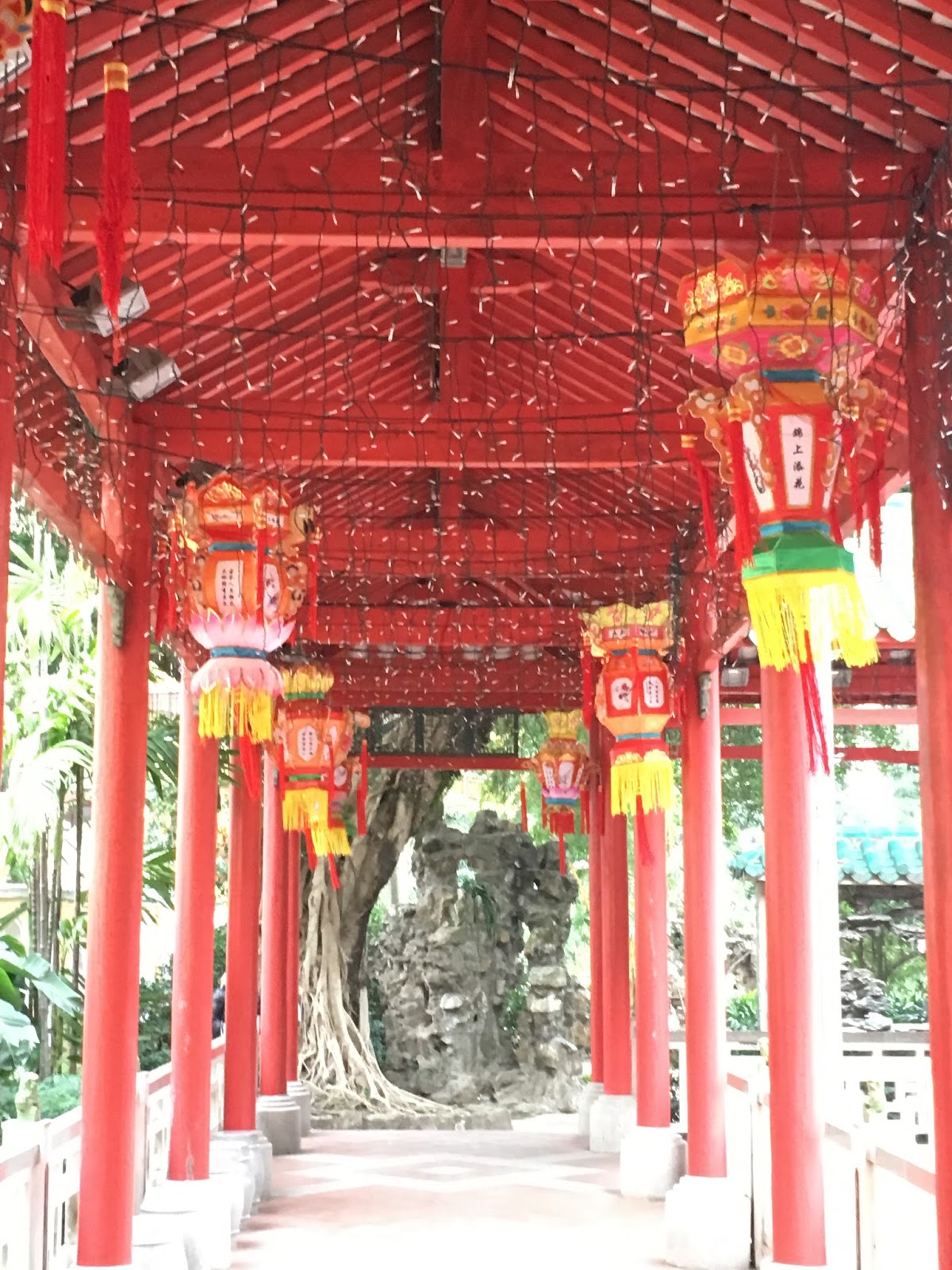
In the Lou Lim Ieoc Garden, Macau

After recently visiting Hong Kong, I had the wonderful opportunity to visit Macau.  I seek out tea experiences wherever I go, and was delighted to learn of the Macau Tea Culture House.  This museum opened in 2005 and is a project of the Cultural Affairs Bureau. Macau was the earliest port from which tea was traded to Europe. Super cool for we tea geeks!  Below are some of the things one will see here.  If you manage to be in Macau, most definitely visit!  The adjoining Lou Lim Ieoc Garden is also a must-see. 

The building is in Portuguese style, showing the connection between Macau and Portugal

Inside, one finds the smell of roasting tea, and a collection of tea utensils - tracing the development from handleless cups

To handles


A replica of a table at the famous Kun Nam tea house, in operation from 1953 - 1996


Upstairs, a replica of a tea house

And a very fine collection of clay teapots

Saturday, February 10, 2018

Yum Cha in Hong Kong, Lock Cha Tea House


Yum Cha is a practice, associated with Hong Kong and Cantonese-speaking parts of China, of having tea and dim sum (a variety of small dishes).  It's like brunch. I was recently in Hong Kong and had a chance to visit the Lock Cha tea house to enjoy this custom.


See the tea kettle to the side?  It's cleverly built into the table. 

We enjoyed a yellow tea (top) and a Phoenix oolong (bottom). 
The oolong was called "greenish" tea in English. 


Veggie dumplings

Cakes of pu-erh and other tea

Saturday, April 01, 2017

Portland Japanese Garden Cultural Crossing


Architect Kengo Kuma in front of  the Jordan Schnitzer Japanese Arts Learning Center

It's an exciting and important weekend here in Portland! The Japanese Garden opens the Cultural Crossing expansion, to members today and to the public tomorrow. This $33.5M project began 10 years ago as part of a master site planning process. I had the good fortune to attend the media day, and I am eager to share what I learned. 

Umami Tea Cafe with beloved Yoshino cherry tree just about to bloom

First, there was a 2-year search to find the right architect. Internationally renowned Kengo Kuma rose to the top of those in consideration. But how to get someone of such stature to consider a project of (relatively) small scope?  After all, he is designing the 2020 Olympic Stadium in Tokyo. Garden CEO Stephen Bloom had a plan. He invited Kuma to visit Portland as a guest lecturer, and allowed the garden to work its magic. Kuma saw the potential and the importance of the project, and here we are today.

New entry to the garden - the Tanabe Welcome Center
Near the parking lot at the base of the hill

There were three main goals with this project: 
  1. Manage the growing attendance of the garden to respect its peace and quiet, and protect the fragile landscape. Attendance has grown rapidly in the past few years, from 120K in 2005 to 400K in 2016. The  new cultural crossing expands the garden's footprint to allow more space for the visitors to span.
  2. Provide more opportunity for cultural education. In fact, the Japanese Garden Training Center, the first of its kind in the US, will be established.  This program, taught in English, will provide courses for amateurs and professionals, and serve as way to develop a community of skilled caretakers for the ~250 Japanese gardens in the US.
  3. Address logistics issues, providing more accessible space for people with disabilities. In addition, create a safer and more pleasant environment for pedestrians as they enter the garden.

As you walk up the hill and cross the glass-sided bridge, notice how the tea cafe appears to float

CEO Stephen Bloom: "We are no longer just a garden. In fact, we are a center of culture and art for Japan."

Additional features include a larger gift shop, the Umami Cafe - a beautiful space to have a bowl or cup of tea, and the castle wall.


Shiro-zumi Castle Wall, function and beauty

This wall was built in the traditional manner of dry stacking rock. It serves as a design feature and a retaining wall for the steep slope behind. The project leader, Suminori Awata, is a 15th generation Japanese stone mason.


Sadafumi Uchiyama, Garden Curator
Diane Durston, Arlene Schnitzer Curator of Culture, Art & Education

Also quoting Stephen Bloom, "It takes a village to make a village."  Many dreamers and doers have been involved for the long span of this work. In addition to the leadership of Stephen Bloom, Sadafumi Uchiyama has worked tirelessly to bring the expansion to fruition in a way that maintains respect for the original garden and allows for new services. Sada-san was emotional as he told us about his journey over the past several years. Likewise, Diane Durston spoke about her excitement at the expanded educational and cultural programs the garden will now be able to offer. 

There's so much more to show and tell, and the best way to experience this is to visit. I recommend you allow yourself to go slowly, quietly. The Cultural Village and the gardens will speak for themselves. 

Saturday, November 26, 2016

Toraya Cafe - Kyoto

Beautiful views of the interior garden at the Toraya Cafe

One of my favorite experiences while in Kyoto was wandering little streets, with my dear friend AM, and discovering the Toraya Cafe (Toraya Karyo Kyoto Ichijo). Returning to this little piece of heaven is a must-do the next time I visit. 

I had known of Toraya, a famous maker of Japanese confections and tea sweets, from my tea studies. The company has been around since the 16th century, and is well known for its yokan. At the cafe, you can enjoy these sweets and a delicious bowl of matcha or brewed tea. If the weather is nice (and in late October, it was perfect), sit outside and take in the peace and beauty of the garden. 


I love this photo!

Enjoy these photos, and imagine a peaceful breeze that gently ripples the water, delicious and artful sweets, tea that both stimulates and soothes, and nurturing conversation. This was my experience. 


Matcha and kuri (chestnut) yokan


Sencha, with an edamame custard with brown sugar glaze


I will close my eyes and go there too.

If you visit Kyoto, here's a tip: One of the retail shops is near the west side of the Imperial Palace. The cafe is tucked about a block down the side street.

Monday, November 07, 2016

Kyoto Sweets


I recently visited Kyoto, Japan with my Chado (Japanese Tea Ceremony) Sensei and three other students. I learned so much about Chado and Japanese culture.  We had lovely weather and incredibly generous local hosts.  A primary goal was to have sweets and tea every day (often more than once).  And so... an obvious way to start summarizing is through a sweets play-by-play!  Here's most of them, with a bite of context for each.  (Not included are some very special sweets from events we attended that will live on in our hearts, but not in photos.) 

Photo credit: Marjorie Yap

These sweets hold a special place in my heart. They were from our first tea experience in Kyoto, at Ochaji Cafe. Yamaguchi-san gently guided our jet-lagged bodies and minds through a lovely light meal, thick tea (koicha) and thin tea (usucha).  The sweets above are the traditional kinton style of wagashi ("wet" sweet), soft sweet bean or sweet potato paste that has been grated. It's served before koicha. So delicious and lovely.  The sweets below (higashi, "dry" sweets) were served just before the usucha. Crunchy apple-flavored sugars, chewy jelly strips and senbei (crispy rice crackers, lightly sweetened, with a thin film of miso paste).

Photo credit: Marjorie Yap

We enjoyed the persimmon mochi sweet below in Arashiyama. The outer dough is soft and chewy, filled with a persimmon/bean paste.  The tops are from real persimmons.

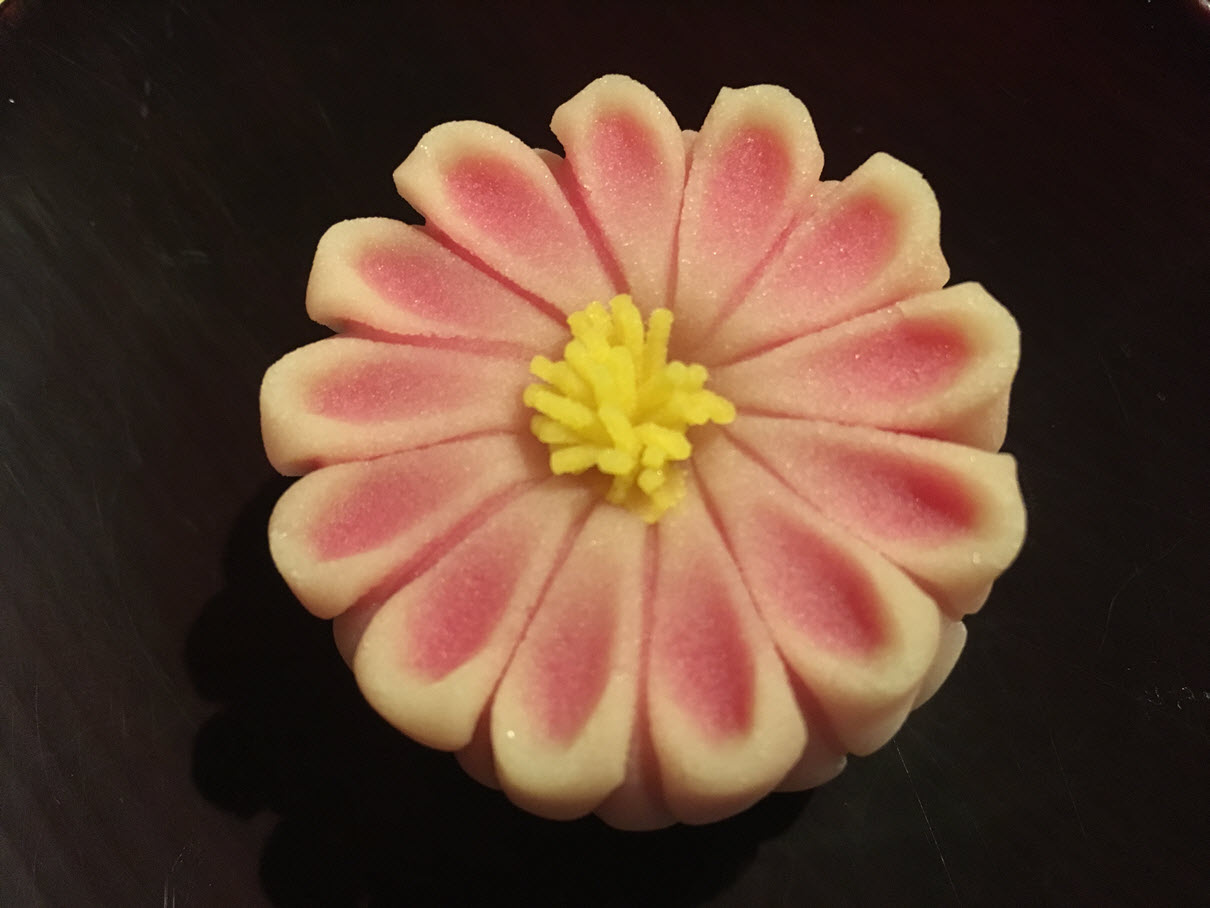
This beauty is from a sweets bar (think sushi bar), where the expert makes the sweet right in front of you.  If you haven't figured this out, sweets in Japan are all about seasonality!  This is a chrysanthemum. 

The sweets below were from an assortment served to us at the famous Ippodo shop on Teramachi.  Kinton (upper left) in autum colors, wrapped yokan and on the bottom,  manju - a rice bun filled with - you guessed it.   Bean paste!

A friend and I visited the Kyoto Confectionery Museum. While the descriptions were in all Japanese, we still learned and enjoyed from the experience, especially the tea and sweets at the end. Lucky us, it's chestnut season. We savored a glazed chestnut and a bean paste chrysanthemum.  


Now on to Toraya, which is worthy of a post unto itself!  For now, let me say that it's a bit of heaven - serene and with great tea and sweets.  The two delicacies below are from there.  The first, a green soybean (edamame) and silken tofu square, in a brown sugar sauce.  The second, yokan with chestnut pieces. (Since being home less than a week, my friend has replicated this yokan with success, I am delighted to say!)


Next up - a sweets class!  We got our chance to practice hand forming the sweets.  One of these below is the professional ginko leaf, one is not.  It's easy to tell.  :-)

I did a little better with the persimmon sweet.  They all four tasted great.  

And here is another (professional) variation of the chrysanthemum.  Notice the delicate fade of white to purple in the center.  The secrets: lots of patience, practice and precision.

The sweet below is another favorite among favorites.  My girlfriend and I were wandering the back streets near Daitokuji temple. We found a tiny little sweets shop (many of them are), which seemed to specialize in this interesting mochi.  It's filled with bean paste, with some whole beans to give texture, and a savory/saltiness to the mochi. Unusual and delicious!

Photo credit: Ana Martinez

Another trip to Toraya...


And then a day trip to the famous tea-growing region and tea-company town, Uji.  During an informative tour at the matcha company Marukyu-Koyamaen, we enjoyed this dango sweet. 

Later that day, after I wandered through tea shop after tea shop, I enjoyed this sweet at the Kanbayashi cafe. It's hard to tell in the photo, but there is a chestnut at the center, and it's surrounded by what might be kudzu-gelatin-based "leaves." that wrap around.  Of course, delicious.

Next, a small pause in our schedule before we headed to the countryside for the final leg of the trip. Four sweets below from the Japanese Tea & Gallery Kyoto Saryo in Kyoto Station. 


And finally - a feast of sweets to close out our last dinner in Japan.


What an indulgence - to live where there is a Japanese sweets shop within easy walking distance of wherever I go!