Showing posts with label Wagashi. Show all posts

Saturday, November 26, 2016

Toraya Cafe - Kyoto

Beautiful views of the interior garden at the Toraya Cafe

One of my favorite experiences while in Kyoto was wandering little streets, with my dear friend AM, and discovering the Toraya Cafe (Toraya Karyo Kyoto Ichijo). Returning to this little piece of heaven is a must-do the next time I visit. 

I had known of Toraya, a famous maker of Japanese confections and tea sweets, from my tea studies. The company has been around since the 16th century, and is well known for its yokan. At the cafe, you can enjoy these sweets and a delicious bowl of matcha or brewed tea. If the weather is nice (and in late October, it was perfect), sit outside and take in the peace and beauty of the garden. 


I love this photo!

Enjoy these photos, and imagine a peaceful breeze that gently ripples the water, delicious and artful sweets, tea that both stimulates and soothes, and nurturing conversation. This was my experience. 


Matcha and kuri (chestnut) yokan


Sencha, with an edamame custard with brown sugar glaze


I will close my eyes and go there too.

If you visit Kyoto, here's a tip: One of the retail shops is near the west side of the Imperial Palace. The cafe is tucked about a block down the side street.

Monday, November 07, 2016

Kyoto Sweets


I recently visited Kyoto, Japan with my Chado (Japanese Tea Ceremony) Sensei and three other students. I learned so much about Chado and Japanese culture.  We had lovely weather and incredibly generous local hosts.  A primary goal was to have sweets and tea every day (often more than once).  And so... an obvious way to start summarizing is through a sweets play-by-play!  Here's most of them, with a bite of context for each.  (Not included are some very special sweets from events we attended that will live on in our hearts, but not in photos.) 

Photo credit: Marjorie Yap

These sweets hold a special place in my heart. They were from our first tea experience in Kyoto, at Ochaji Cafe. Yamaguchi-san gently guided our jet-lagged bodies and minds through a lovely light meal, thick tea (koicha) and thin tea (usucha).  The sweets above are the traditional kinton style of wagashi ("wet" sweet), soft sweet bean or sweet potato paste that has been grated. It's served before koicha. So delicious and lovely.  The sweets below (higashi, "dry" sweets) were served just before the usucha. Crunchy apple-flavored sugars, chewy jelly strips and senbei (crispy rice crackers, lightly sweetened, with a thin film of miso paste).

Photo credit: Marjorie Yap

We enjoyed the persimmon mochi sweet below in Arashiyama. The outer dough is soft and chewy, filled with a persimmon/bean paste.  The tops are from real persimmons.

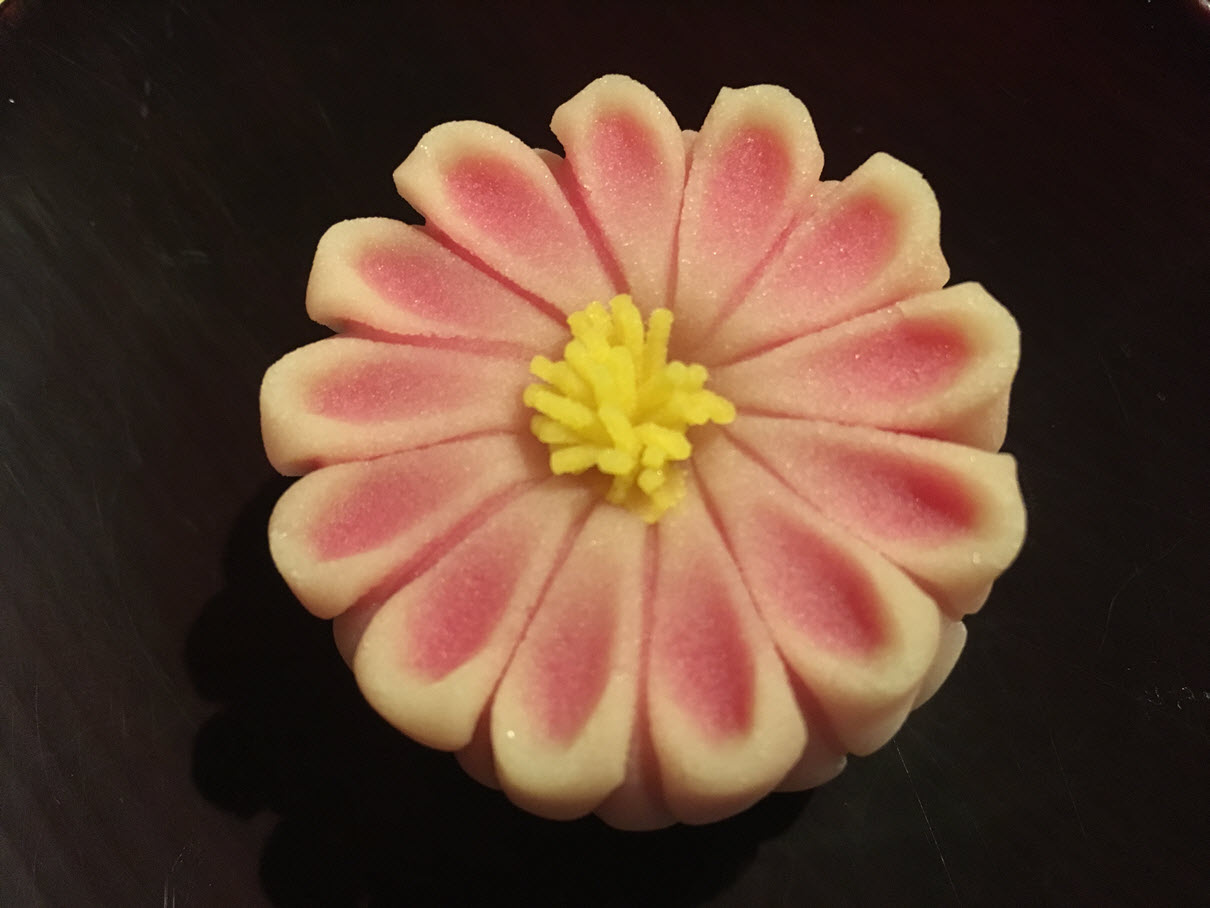
This beauty is from a sweets bar (think sushi bar), where the expert makes the sweet right in front of you.  If you haven't figured this out, sweets in Japan are all about seasonality!  This is a chrysanthemum. 

The sweets below were from an assortment served to us at the famous Ippodo shop on Teramachi.  Kinton (upper left) in autum colors, wrapped yokan and on the bottom,  manju - a rice bun filled with - you guessed it.   Bean paste!

A friend and I visited the Kyoto Confectionery Museum. While the descriptions were in all Japanese, we still learned and enjoyed from the experience, especially the tea and sweets at the end. Lucky us, it's chestnut season. We savored a glazed chestnut and a bean paste chrysanthemum.  


Now on to Toraya, which is worthy of a post unto itself!  For now, let me say that it's a bit of heaven - serene and with great tea and sweets.  The two delicacies below are from there.  The first, a green soybean (edamame) and silken tofu square, in a brown sugar sauce.  The second, yokan with chestnut pieces. (Since being home less than a week, my friend has replicated this yokan with success, I am delighted to say!)


Next up - a sweets class!  We got our chance to practice hand forming the sweets.  One of these below is the professional ginko leaf, one is not.  It's easy to tell.  :-)

I did a little better with the persimmon sweet.  They all four tasted great.  

And here is another (professional) variation of the chrysanthemum.  Notice the delicate fade of white to purple in the center.  The secrets: lots of patience, practice and precision.

The sweet below is another favorite among favorites.  My girlfriend and I were wandering the back streets near Daitokuji temple. We found a tiny little sweets shop (many of them are), which seemed to specialize in this interesting mochi.  It's filled with bean paste, with some whole beans to give texture, and a savory/saltiness to the mochi. Unusual and delicious!

Photo credit: Ana Martinez

Another trip to Toraya...


And then a day trip to the famous tea-growing region and tea-company town, Uji.  During an informative tour at the matcha company Marukyu-Koyamaen, we enjoyed this dango sweet. 

Later that day, after I wandered through tea shop after tea shop, I enjoyed this sweet at the Kanbayashi cafe. It's hard to tell in the photo, but there is a chestnut at the center, and it's surrounded by what might be kudzu-gelatin-based "leaves." that wrap around.  Of course, delicious.

Next, a small pause in our schedule before we headed to the countryside for the final leg of the trip. Four sweets below from the Japanese Tea & Gallery Kyoto Saryo in Kyoto Station. 


And finally - a feast of sweets to close out our last dinner in Japan.


What an indulgence - to live where there is a Japanese sweets shop within easy walking distance of wherever I go!

Monday, June 23, 2014

Making Shiro An (White Bean Paste)

"Mountain" of Shiro An

Shiro an, a white bean paste that is lightly sweetened, is the base of so many Japanese  tea sweets.  And I love it.  Love it.  LOVE it!  I know that sweetened bean paste sounds funny to Americans, but it really IS good!  When I began studying chanoyu, I had no idea how much I would come to love the sweets that go along with the tea.  What a wonderful surprise!  And sweets with shiro an are one of my favorites.

While it's possible to buy the red bean paste in the Asian markets around here, it is not possible to find the white paste.  So earlier this year I tried making it myself.  My sensei had prepared me well for the all-day process!  You can find her detailed steps here.  If you attempt this, please do use her recipe.  My notes below don't include all the steps.

First you buy dried Lima beans and sort through them, then let them soak overnight. Then comes the part that was hardest for me: Peeling the skins off the beans.  I was making a big batch (because you don't want to do this very often!), and so I had a lot of skins to remove.  Fortunately, they slip off easily.


Then you enter into several rounds of bringing the beans to a bowl and changing the water.  Repeat, repeat until the beans are falling apart.  Then you send the beans through the food processor.  Now you let the liquids and solids separate, draining off the liquid (this also takes several rounds).

Finally, you are ready to add some sugar.  Add the sugar in small increments and stir, stir, stir until  it is the right consistency.  Whew!  
Still needs to be a little thicker - keep stirring!

Fortunately, shiro an freezes really well and will make for many happy tea times in the future!  The bean paste is very mold-able and flexible.  It can be colored and made into interesting shapes, traditionally something that suggests the season.  If you ever get the opportunity to try a sweet made with shiro an, please do!  It's naturally gluten free and fat free, too.  And there's only a little sugar.  Big on taste and texture!


Thursday, March 13, 2014

Robin's Egg Blue: Japanese Tea Sweet


I've been having so much fun playing with Japanese tea sweets!  This is one of my favorites.  It's made from a center of red bean paste, surrounded by white bean paste for the nest.  The little blue eggs are white bean paste that I colored.  (The bean pastes are sweetened.)

The naming of sweets is an important part of the process, as the guests may want to know the story of the sweet.  I'm learning what makes a good sweets name.  Generally, it should be something suggestive of the season, and poetic.  Do you have ideas for a name for this sweet?     


Wednesday, February 19, 2014

Sprouts Under the Snow (Japanese Sweet)

Sprouts Under the Snow

Recently, we had snowy weather in Oregon!  I was also playing around with my first batch of shiro an, a sweet bean paste made from white beans.  I'll write more about the process of making the bean paste soon.  But for now...the sweet.

This type of sweet is served with matcha, powdered green tea, during the Japanese Tea Ceremony.  It's customary to provide a poetic name to things...to utensils, the tea bowl and to sweets.  So in that spirit and given the weather, I named this sweet "sprouts under the snow".  This sweet is nothing more than bean paste and sugar (with a dot of food coloring).  It's naturally vegan and gluten/soy/dairy-free, so a great sweet for anyone with food allergies.  It's also DELICIOUS!  I know that sweetened bean paste sounds a little funny to most of us Americans, but it really is yummy! 


Daffodil sprouts under the snow

Saturday, December 28, 2013

Sharing Matcha over the Holidays


I had the wonderful opportunity to make matcha for a good friend and my niece while visiting my family over the Christmas holiday. It's always a gift to me to serve tea to those I love. 

My Japanese tea teacher shared with me some white bean paste (Lima beans cooked down, with sugar and a bit of rice flour - it's an all day process), and I had some red bean paste frozen. These made it through airport security "). I made traditional Japanese tea sweets for my guests. The grown up guest liked it and my niece thought it was OK. I was impressed she even tried it!

In fact, she was eager to be my helper and try everything. The horses came along too. 

I made the matcha very very light for her, and with plenty of froth. She liked it!  That's my girl!

Sunday, January 27, 2013

Anticipation

This is a sweet for the Japanese Tea Ceremony.  Sweets have poetic names, I love that!  Sweets for usucha (thin tea) are often named with a nod to the season.  Names for the koicha (thick tea) sweets are more zen or abstract.  I have learned that poems are a great source for naming both, though there remains still an art to selecting just the right name.

I learned to make this sweet on Saturday.  The base is a sweetened white bean paste (which took my sensei all day to make!).  We added in a bit of pickled plum paste and a touch of gold flake.  I call it Anticipation.  The daffodils have begun to push out of the earth, their golden heads I long for.

Tuesday, July 03, 2012

Daifukumochi

Daifukumochi
Sweet red bean paste centers, covered with rice-flour dough (mochi)

In the Japanese Tea Ceremony, guests enjoy a sweet before consuming the matcha (both thin and thick versions).  The sweet provides contrast and complement to the intense matcha tea.  Over the past six months, I've discovered that I love Japanese sweets!  They are unlike American sweets: no creams, fats or heavy sugars.  In fact, they are often comprised of sweetened bean paste or simple pressed sugars.  But they are poetic, textural, beautiful and to my liking.

My teacher, Margie-sensei, has shared a recipe for making a daifukummochi.  You can find the original recipe here.  It's surprisingly simple, though not necessarily easy.  The pictures show my first attempt.  I will be making this again!

Recipe courtesy of Margie, of the Issoan Tea School.  To begin, you must find the right ingredients.  You'll need sweet rice flour.  (This is made from sticky rice and be sure that it says "sweet" rice flour.  Bob's Red Mill carries it locally at New Seasons markets.)  You'll also need red bean paste, most easily found at an Asian grocer.  (It freezes well.) You'll also need sugar, light Karo syrup and corn starch.

Balls of sweetened red bean paste

Make little balls of red bean paste.  I found that cooling these in the fridge works well because when warm, they get a little squishy and hard to handle. 

Stir together the flour, sugar and water in a 1:1:1 ratio.  Press through a sieve to remove lumps.  The results should go into a microwave-safe bowl.  Add food coloring and 1 Tbsp of Karo syrup (assuming you are using 1 cup of each main ingredient).  Give it all a stir.
Mochi mixture

Into the microwave with it, and cook on high for one minute.  Stir and repeat in one-minute increments until the mixture becomes stretchy and translucent.  Dump the sticky mochi mass (not so easy) onto a plate that has been well-dusted with corn starch.  Let the mochi cool enough to handle, but not so cool that it becomes tough.  Playing hot potato, pinch off small amounts (enough to cover a bean paste ball) and flatten in your palms.  Pinch around the red bean paste balls, dusting with corn starch as you go for easier handling. 

These are best served within 24 hours.  I keep mine in the fridge.  They really are delicious!

Thursday, April 28, 2011

Wagashi

Photo by Mitra
Kanten, cherry blossom floating in agar agar

So many times I have mentioned feeling really fortunate here in Portland because of the interesting and active network of tea people and tea events.  Well, here I go again!  The opportunities keep expanding.  Here's my most recent adventure - to a wagashi tasting at a newly-opened tea bar, the Jasmine Pearl. 

Wagashi is a traditional type of Japanese sweet.  It's served before the tea in the Japanese Tea Ceremony.  (It's also used at other occasions.)  These sweets are prized for their visual appeal and texture, along with taste.  (Read more here.)

Not only did I get to taste these gems, but I also got to chat with the confections maker!  Please meet the owners of the tea room, Heather Agosta and Chuck Bauman, (left and center) and the wagashi maker Gena Renaud.
Tea room owners and wagashi maker

From left to right, sea glass, kanten (from agar agar), mochi with toasted soy flakes, and baked manju.


Sweets enjoyed with a beautiful cup of whisked matcha.

Sea glass.  To the touch, it feels solid and hard, but a surprise awaits your first bite!
Photo by Mitra
Mochi, a pounded rice flour confection.  This was dusted with toasted soy flakes.
A lovely texture, soft and mildly chewy.
Photo by Mitra

Look at how lovely the cherry blossom floats in this see-through half moon.  The cherry blossom is pickled, so it's a pleasant contrast to the sweet gelatin.
Photo by Mitra

A sunny, spring afternoon with tea-loving friends, what could be better?

To those of you who will be doing the Royal Wedding festivities with tea parties, etc....enjoy!  I'm skipping out for other plans, but will look forward to reading your blog. Cheers!